Press ESC or click the X to close this window

Caged Sisters (Susan Elkin reviews)

Book and Director: Sheldon Long

Musical director: Yezi Guo

This Camden Fringe show is presented as “work in progress” and that’s very much what it is, so it is appropriate to gloss over the patchy singing, the clunky scene changes and other shortcomings.

Inspired by Honglu Meng – a famous and influential Chinese novel by Cao Xuequin (1710-1765) – it tells the story of two sisters of aristocratic birth who are constrained by rigid social conventions. They take different paths, neither of which brings happiness. You San (Yiqian Shao – good) wants a love relationship unsanctioned by her family, which ends in betrayal. You Er (Yiting Jiang – fine singer)  stays at home but has a relationship with a family member and becomes pregnant. In many ways, it’s a feminist piece. These women are caged by tradition.

The music is odd. It connotes China with snatches of pentatonic scales and tam tams, but frequently resorts to thick, full orchestral texture as if we were in Turandot or something by Andrew Lloyd Webber. Although the women are, in general, better singers than the men, there is some pleasing duet work in harmony, usually with the two voices a major third apart.

The use of the Bridewell’s centre aisle as an extension of the playing space is effective because it’s nicely lit, and Yixuan Qiu’s traditional costume designs are a delight with lots of floaty silk in soft colours.

The best moment in the whole show comes three-quarters of the way through when a sinister turbaned figure (Sok-Ho Trinh) bursts out of a trap door, a cross between Abanazar and Caiaphas. He is the doctor, summoned to sort out You Er. We get off-beat rhythms and an arresting minor key song as he forces an abortifacient down her throat. It’s powerful, and her grief at the outcome is quite moving.

It is good (and unusual) to see  Bridewell Theatre fully sold out. Many of the audience are, inevitably, enthusiastic supporters of cast members, so there is a lot of supportive laughter simply because someone appears, and that gets quite irritating, especially when the same audience members can’t stop chattering amongst themselves.

While the storytelling could be stronger, Caged Sisters is a brave effort at fusion theatre, enjoyable in places, even in its present “in development” phase. It does not, however, need an interval to bulk out its length. It would work perfectly well as a 60-80 minute straight-through performance. There is, moreover, an over-reliance on voice-over.

Runs until 30 August 2025

The Reviews Hub Star Rating: 2.5

Commendable effort but needs more work

REVIEW: Don Giovanni, Grimeborn Festival at Arcola Theatre 26 – 30 August 2025

Susan Elkin • 31 August 2025

‘Outstanding achievement’ ★★★★ ½

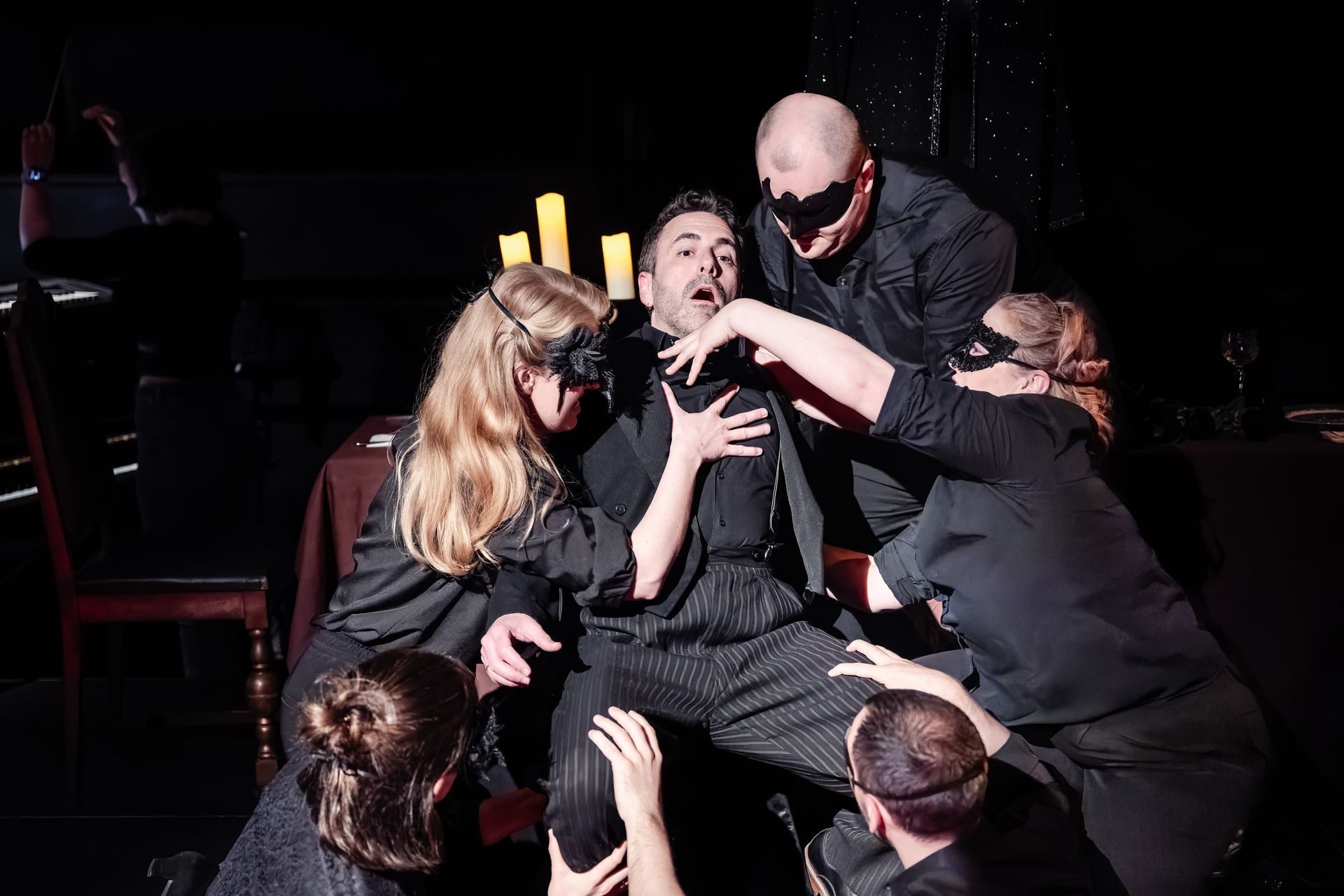
One of the best productions of Mozart’s 1787 masterpiece I have ever seen, this chamber version of Don Giovanniuses every inch of the Arcola’s challenging Studio 1 space to good effect. We hear every note of the glorious score, played by string quartet with bassoon, clarinet, flute and double bass superlatively conducted (at the performance I saw) by Andreas Levisianos who also plays harpsichord-style accompaniments to the recitatives.

Marcio da Silva is extraordinarily talented. He sings Don Giovanni at two performances including the one reviewed here. At other performances he conducts while Oshri Segev sings the title role. Da Silva also directs both stage and music for this production which uses a cast of eight singers plus a puppeteer and an actor.

The story is, of course, familiar in various guises. In Lorenzo Da Ponte’s version, as set by Mozart, the titular character is a callous, unrepentant womaniser who accidentally murders the father of one of his victims. Eventually his deed literally comes to haunt him and he gets what he deserves – after 180 minutes of the most glorious music ever written.

High spots in this production include Da Silva’s singing of the aria in which he attempts to seduce Zerlina (Anna-Louse Wagner – good) having calculatedly wrested her from her fiancé Masetto (Jay Rockwell). It’s exquisitely simple, with Flavio Lauria as a fine Leporello supporting his master with a guitar accompaniment. Da Silva sings it so seductively that you can almost feel her yielding. I’d have given in too. Then there’s the way Helen May (as Donna Elvira) does anger and hauteur and Rosemary Carlton-Willis singing her famous love song to Don Ottavio, a very pleasing anguished tenor. In short, this production had me smiling continuously.

And incidentally, I have never heard Italian diction as clear as this in an opera by Mozart or anyone else. I am not an Italian speaker but meaning and articulation are so precise that the surtitles are almost unnecessary.

Theatrically there are some interesting ideas. A pretty sinister, slightly larger than life, white statue puppet represents the ghost of Il Commendatore at the end with Verdat Daigran (delicious gravelly basso profundo) singing in the shadows. It solves the problem of how to stage this tricky scene quite neatly although the singer could have been off stage or on the balcony. The set is fairly basic (a multi-purpose brown sheet more than earns its keep) but there has to be some shifting of chairs and so on. One of these moments is covered by the orchestra ensemble playing part of Mozart’s 40th Symphony which was written within a months of Don Giovanni and works well here.  

Of course it’s not perfect. This is live theatre and inevitably there are some brief ragged moments – although full marks for the septet. Does anyone do multi-person arguments as well as Mozart? I have no idea why everyone is dressed in black and the silhouetted singing from the balcony above the orchestra doesn’t add much. Neither does the audience participation moment although it’s very funny.

Overall though, this Don Giovanni is an outstanding achievement. Ensemble OrQuesta did The Marriage of Figaro beautifully at the Grimeborn Festival last year. I hope they’re planning more Mozart for 2026. 

Photography; Julian Guidera

Don Giovanni

Wolfgang Amadeus Mozart

Ensemble OrQuesta with Hastings Philharmonic Orchestra Ensemble

Arcola Theatre

https://www.ensembleorquesta.com/whats-on/don-giovanni-grimeborn

Marcio da Silva Stage/Music Director                                                                                  Marcio da Silva, Beth Fitzpatrick, Andreas Levisianos Conductor

Marjorie Lemos, Orlando Bishop Assistant Director

Ensemble OrQuesta Company

Oshri Segev (28th/30th), Marcio da Silva (26th/27th/29th) Don Giovanni

Flavio Lauria Leporello

Helen May Donna Elvira

Rosemary Carlton-Willis Donna Anna

Anna-Luise Wagner Zerlina

John Twitchen Don Ottavio

Jay Rockwell Masetto

Vedat Dalgiran Il Commendatore

Orlando Bishop Puppeteer

Marjorie Lemos Actress

This review was first published by London Pub Theatres Magazine: https://www.londonpubtheatres.com/review-don-giovanni-grimeborn-festival-at-arcola-theatre-26-30-august-2025

Grimeborn Opera Festival: Tristan und Isolde by Richard Wagner at Arcola Theatre

Susan Elkin • 17 August 2025

‘Intimate yearning, finely sung’ ★★★★


I always think that watching a Wager opera is like flying to Australia. You know you’ll arrive eventually. In this case we took off at 6pm and finally landed at Sydney airport – or at least at the Liebestod, arguably the most sublime musical expression of love ever written – at 10.15pm. Wagner had no patience with performers or audiences who lack stamina.

Tristan und Isolde, which debuted in 1865, is here sung in German with English subtitles. Wager famously wrote his own libretti, and his words are usually overblown to the point of pomposity. It’s hard, therefore to know how best to translate them without losing the writer’s distinctive voice. And the decisions made here are sometimes clunkily erratic in their literalness. “The yearning that drove me to live anew” and “drove me madly from heart to brain” are risible. On the other hand “That adventure will be such a lark” doesn’t sit right either. It’s a problem which this production doesn’t quite solve.

It’s fascinating to see a grand (in every sense) opera reworked in chamber form. Michael Thrift’s interesting version of the score is arranged for string quartet with piano, occasionally joined by three off-stage wind players. They sit, cramped under a corner balcony, which occasionally features in the action. And full marks to every one of them. It was drippingly hot in Arcola’s Studio 1 when I saw this show and yet, slippery fingers notwithstanding, these fine musicians delivered every nuance with aplomb and rarely an infelicitous note or corner.

Wagner more or less invented the leitmotiv: a recurrently used musical phrase or motif to represent a character or idea. Here the overture opens with the series of evocative unresolved chords which we hear many times over the next 255 minutes. They remind us that the love between Tristan and Isolde will always be troubled until the very end when they’re united in death. Thrift’s arrangement ensures that we both hear and notice them.

Guido Martin-Brandis makes good directorial use of the space which has seating on three sides and three entry points. No one is far from the performers so the piece – usually mounted on a huge scale suddenly becomes very intimate. That’s a challenge for actors but these seven performers rise to it with aplomb.

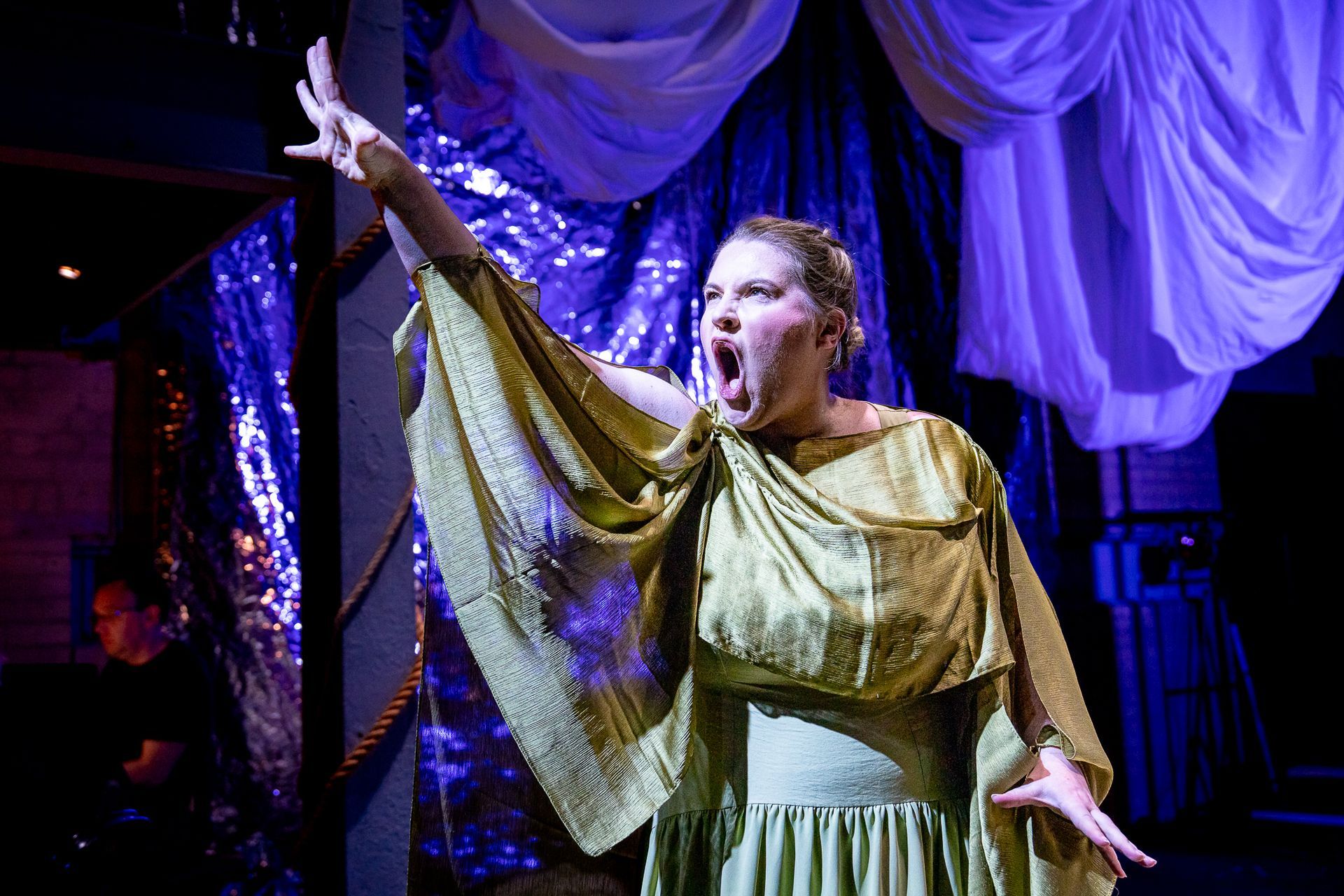
I often think that this opera should be called Isolde und Tristan but, of course, that’s not the way Wagner operated although Isolde is definitely the lead. Becca Marriott is listed as “cover Isolde” and sings only one of the three performances but she is astonishingly good.  She has a rich voice with a wide range of colour from vibrato low notes to penetrative golden soprano ones which take the listener by surprise. Moreover, her face is unusually expressive and she knows exactly how to use it, especially in Act 2 when she and her Tristan (Brian Smith Walters – good) are caught in flagrante. She is a fine actor.

Other pleasing performances include Simon Wilding whose chocolate brown bass voice finds all the hurt, disappointment, wisdom and gravitas that Konig Marke needs when he discovers that Isolde is not for him after all. And Laureen Easton delights as Isolde’s common-sensible but devious servant/companion, Brangane.

It’s not always easy to take the love potion (an operatic precursor to viagara?) plot seriously because it crops up more often in comic romps such as Donizetti’s L’elisir d’amore or Gilbert and Sullivan’s The Sorcerer. But you have to meet Wagner on his own terms. Tristan und Isolde is a deadly earnest exploration of the psychology of attraction. If Wagner knew any jokes he kept them to himself.  Tristan is meant to be ferrying Isolde to Cornwall to marry his uncle, Konig Marke. But there’s history between them. And when Brangwane substitutes an aphrodisiac for the poison Isolde and Tristan think they’re drinking in a suicide pact, they give vent to their hitherto suppressed yearning. The tenderness they then find is nicely done in this production – especially in the “Night of Love” duet which they start back-to-back with fingers interlaced and the audience can almost feel the erotic quivering of their muscles. Incidentally, this was sung in such a way that it sounded as if it was written at least 50 years later by, say, Richard Strauss but was none the worse for that.

Caitlin Abbot’s set and Davy Cunningham’s lighting help to build atmosphere. Crumpled foil, gauzy white drapes which become bandages and a model boat are often flushed passionate red and it’s pleasingly supportive of the action.

Photography: Steve Gregson


Tristan und Isolde by Richard Wagner at Arcola Theatre

Shatter Brain/Regents Opera

MD/Arranger: Michael Thrift

Director: Guido Martin-Brandis

Grimeborn Festival of reworked Operas runs 16 August – 13 September at Arcola Theatre

https://www.arcolatheatre.com/whats-on/

This review was first published by London Pub Theatres Magazine: https://www.londonpubtheatres.com/grimeborn-opera-festival-tristan-und-isolde-by-richard-wagner-at-arcola-theatre

What a Gay Day!

Tim Connery

Directed by Alex Donald

Jack Studio, part of the SE Fest.


Star rating: 4


This play is a straightforward first person account of Larry Grayson’s life featuring a bravura performance from Luke Adamson. He holds the audience in the palm of his hand for eighty minutes making sure that we laugh (a lot) sigh and even wipe away the occasional tear.

There’s a framing device about a medium which doesn’t add much but thereafter Adamson shifts seamlessly and repeatedly between Grayson, downstage performing to an audience to a much more thoughtful real life account of Grayson’s personal life and career mostly presented upstage. Adamson changes his voice and manner repeatedly as he morphs between the two personas. The script gives the performing Grayson dozens of outrageously funny double-entendres which Adamson times beautifully with a good line in knowing looks. At times the gestures begin to feel a bit samey and predictable but this is a pretty well observed account of how Grayson actually was.

Grayson specialised in camp comedy and it was a long time before this became acceptable to, for example, BBC audiences. And even when it did, he had the Gay Liberation Front on his back accusing him of presenting an unhelpful stereotype. Grayson never came out as homosexual simply claiming to be a “confirmed bachelor”. The closest friendship he ever had was with school friend Tom Proctor, who died in World War Two. And that loss is touchingly presented in this play. So is the relationship with his foster family, especially Fan his quasi-sister who brought him up and lived with him until she had to go into a nursing home. Adamson does Grayson’s affection for his native Nuneaton nicely too.

It’s warmly lit and the set and props are ingenious. Scattered round the stage are items of clothing and other items which Adamson picks up briefly, uses as the focus of a story and then packs them into a suitcase which he carries off at the end.

What a Gay Day is an entertaining, richly funny piece of theatre which also comes with poignancy. Grayson’s life wasn’t always easy – even though at one point he buys a Rolls Royce which he cannot drive but he enjoys sitting in it to eat his fish and chips.

Photograph credit: J Summerfield


It’s unusual to read a book which explores and celebrates male friendship with all its affectionate joshing, trust and respect. We’re so used to reading about male/female liaison in its many forms and/or about gay love that pure, loving friendship between two men is a refreshing change.

Alexander Starritt’s new novel, which is both moving and  absorbing, gives us James Drayton and Roland Mackenzie who meet at Oxford and are very different. James is a focused, super-bright, high achiever who doesn’t always relate comfortably to other people. Roland has people skills, enjoys a good time and messes up his degree. So they hardly notice each other. Later they meet again, find a bond and start an innovative energy company – it has potential, perhaps, but of course investment is an issue and there are many setbacks. Some of the stumbling blocks are driven by phases of differing commitment and loyalty as the novel inches, via its dated sections, towards the Covid years. The complementary relationship between the two of them is like a love affair as they bicker, fall out and rediscover each other repeatedly. Rarely have I read a novel with stronger characterisation.

The minor characters are wonderful too. James’s long-suffering parents, with whom he lives most of the time, are a delight. Both are academics. They take in Roland as a quasi family member and Arthur’s therapeutic, culinary hobby saves the day on more than one occasion. Then there’s Eleni, a rich successful Greek they knew at university who can always be relied on for sensible advice. Alice goes out with James for a while but Roland is easier to be with and, somehow, the two men come round to accommodating the change in dynamic. Some of the characters are real too. It must have been fun to write Drayton and Mackenzie’s meeting with Elon Musk.

Is there a future in tidal energy or hydrolisers? I’m no scientist but Starritt, who has clearly researched it all pretty scrupulously, convinces me that there probably is although there are many heart-in-mouth moments at the beginning, not least when the diver descends to attach the first cable. Starritt is very good at tension and brilliant at naturalistic dialogue.  He also excels at the agony of loss because, of course, life is messy – in novels as in reality.

The novel’s epilogue pitches us forward twenty years so we do actually find out how successful it eventually all was. And I cried. Drayton and Mackenzie –  the book’s title is, of course, the name of the company –  got under my skin in a way that no recent novel has done for a while. It’s intelligent and compelling without ever resorting to shallow literary pretentiousness. I loved it – and wondered why on earth it isn’t on the 2025 Booker Prize longlist.

Next week on Susan’s Bookshelves: Stalin: the Court of the Red Tsar by Simon Sebag Montefiore

BBC PROMS: 22 August 2025
J.S Bach, orch. Ottorini Respighi: Three Chorales
Thomas de Hartmann: Violin concerto
Hemryk Górecki: Symphony no. 3 ‘Symphony of Sorrowful Songs’
BBC Symphony Orchestra
Joshua Bell (Violin)
Francesca Chiejina (Soprano)
Dalia Stasevska (Conductor)

This evening’s Prom was one of reflection on troubled times: pieces inspired by reactions to conflict
and its aftermath.

Respighi’s orchestration of J.S Bach’s chorale Nun komm, der Heiden Heiland (BWV 659) provided a
sonorous, sombre opening. Orchestrated for strings only in large numbers, and in low registers
virtually throughout, it formed a suitable mood-setting piece for what was to come.
Ukrainian composer Thomas de Hartmann’s violin concerto (1943) might be interpreted as a
response to the invasion his homeland by the Germans. In the first movement dark, menacing
orchestral tones set the scene whilst Joshua Bell’s solo violin soars above. At times there are hints of
eastern European folk-music, perhaps indicating happier times whilst hints of mechanised warfare
are never far behind. The second movement lilts with dotted rhythms in the violin, interspersed with
virtuosic arpeggio passages, followed by a short third movement and then a lively, busy finale with
more dance-type rhythms and a frenzied violin part that drive the piece to its end.

Chopin’s 2nd piano nocturne, arranged for violin and orchestra was a very well-considered, calming
encore.

Górecki’s Symphony no. 3 (1976) – a very familiar piece to any 1990s music student, and indeed
many others given its huge popularity at the time – is a vast work when heard complete, running just
short of an hour. The opening statement, played by half the double bass section and built up in
layers rising through the strings, is a type of minimalist fugue. In the central section Francesca
Chiejina’s voice hangs beautifully over the rich tone clusters before the long wind-down through the
strings ends the first movement. In the second, Chiejina demonstrates the remarkable power of
carrying the vocal line through the textures, particularly when singing very low in her register at
pianissimo levels: real pathos to the words of a prayer, inscribed by an 18-year old in the walls of her
cell in a Gestapo prison in occupied Poland in 1944.

Conductor Dalia Stasevska moulds (as much as conducts) the complex soundscapes and I was
particularly impressed by the work of the piano and harp (effectively the only ‘percussion’ used) in
placing their entries. Five or six repeats of the same note at gradually diminishing dynamic, each
several seconds apart, for example – beautifully done.

At the end the audience held silence for perhaps half a minute – the most fitting response to a
remarkable evening of contemplative music.

Chris Power’s 2021, debut novel came to my attention because I recently interviewed Chris, in his 2025 Booker Prize judge capacity, for a magazine. I try to be polite and conscientious so I thought it behoved me to read A Lonely Man before speaking to its author. I had no idea what to expect. In the event it was a delightful surprise which I admired very much – apart from the ending of which more anon.

Robert, who is an author, lives in Berlin with his wife and two young daughters. They also have a lakeside house in her native Sweden. Places are sensuously evoked in this intriguing novel and it is clear that Chris knows them well.

Robert meets another Brit, Patrick, who is also a writer. Incrementally, during a series of furtive meetings, Patrick, anxious and capricious, tells Robert an extraordinary story about being commissioned to ghost-write the memoir of a Russian oligarch who then dies –  officially by suicide but actually under suspicious, hushed-up circumstances. Robert doesn’t really believe a word of it but sees it as a good plot for his new novel which has been proving elusive. Thus, Patrick’s story, as told by Robert who adds fictional detail forms chunks of Chris’s novel. Still with me? In effect it means that A Lonely Man is a story, within a story within a story like a set of Russian dolls. It’s a clever page turner.

The point really, I suppose, is to investigate the nature of truth which isn’t as absolute as it might seem, and perhaps should be, in a world in which people routinely now say “my truth” when they mean “my point of view” or “my interpretation. The word is now often pluralised these days too as in “their truths”. How much truth is there in what Patrick is telling Robert? The reader can see past Robert and begins to suspect that at least some of it might be true. Patrick is very jumpy and moody – and furious when he learns that Robert is “stealing” his story without telling him. There is strong evidence that he is followed on more than one occasion and soon there are some sinister, knowing messages and phone calls.

Finally … well of course I’m not going to spoil the ending for you but we do actually learn, by inference, whether or not Patrick’s story is the fabrication of a clinically disturbed man or whether any of it is true. Or maybe Robert is fantasising as he writes and we are deliberately left to decide for ourselves? Either way It’s all comes to an abrupt stop, and feels like a cop-out by someone who didn’t really know how to conclude his novel. Bit disappointing than, at the last, although I enjoyed it until the final page.

Next week on Susan’s Bookshelves: Drayton and Mackenzie by Alexander Starritt

Writer: Cesar Azanza

Director: Matthew Paul

Cesar Azanza’s two-hander, 50-minute play (in which he also plays Dan) is part of the Camden Fringe Festival. It examines immigration, love, change and adaptation to new circumstances and is very much “work in progress.”

Sitting less than comfortably on Bridewell Theatre’s huge playing space, the play begins with Anika (Vedika Haralalka) finally walking away from Dan at an airport. Then – although the chronology is confusingly blurred – it jumps back and forth to show their relationship from their original chance meeting in a record shop.

They come to love each other a lot, but neither is right for the other just now, although they live together for a while. When he discovers by chance that she has had an abortion without telling him, “the shit hits the fan”. They discuss whether they can clean it up. Probably not. Their relationship lacks the absolute trust that a successful partnership needs.

Both actors put in nuanced, quite convincing performances, with Azanza doing despair and emotional pain particularly well. Their characters are drawn to each other because Dan comes from Chicago and Anika from Bombay, so they are both feeling their way in London and, sometimes, able to chuckle together at British habits. Unfortunately, audibility and clarity are often casualties of the naturalistic dialogue and cavernous stage.

Moreover, given the short length of the piece, the structure is clumsy. There are too many semi-blackout scene changes to connote time shifts as both actors scurry about moving props. It’s tidily enough done, but feels bitty and interrupted.

Initially, the play makes rather good use of silences as Dan and Anika simply look at each other, wait, and we begin to sense their complicated feelings. Then – presumably as a strategy to bulk out the piece’s length – come occasional forays into a sort of dance drama accompanied by Vivaldi’s Four Seasons. They add little or nothing, although the characters do, at one point, discuss their liking, or not, for Vivaldi, which feels like a contrivance to justify the mime interludes.

This is a show with potential, but it still needs a lot of work, followed, maybe, by staging in a much more intimate in-the-round space.

Reviewed on 13 August 2025

Camden Fringe runs until 24 August 2025

The Reviews Hub Star Rating: 2

This review was first published by The Reviews Hub: https://www.thereviewshub.com/camden-fringe-2025-transient-bridewell-theatre-london/