
Press ESC or click the X to close this window

Little Women (Susan Elkin reviews)

Little Women Mark Adamo Opera Holland Park July 2022

The UK premiere of Mark Adamo’s 1998 two act opera was an interesting event. It sits well with Opera Holland Park’s policy of mixing the very well known work with the much less familiar within a single season and features some talented singers at various stages of their careers. It was also good to see the composer there, clearly moved by this account of his work.

We’re in the world of Louisa M Alcott’s famous 1868 novel with glances at its sequels as the four March sisters reflect from maturity on the events of their childhood. As with Carmen and Eugene Onegin the set by takis brings some of the action into the space between the audience and the orchestra which conveys a strong sense of immediate intimacy. For this show the main stage is dominated by a series of huge, distressed picture frames which make the small room scenes convincing and contained.

Adamo’s score – of its time, obviously – is short on sustained melody but strong on orchestral colour. During Brooke’s (Harry Thatcher) impassioned courtship of Amy (Elizabeth Karani) for example, with Jo (Charlotte Badham) trying to stop them, we get timp glissandi, snare drum tattoos and glockenspiel. And I like Adamo’s use of tubular bells. Both percussionists (Glynn Matthews and Jeremy Cornes) work very hard in this opera and the results are often arresting. Meanwhile there’s some good work in other sections in a piece which often sets up unusual combinations of instruments all well managed by Sian Edwards on the podium. The sympathetic playing here is testament to the long partnership between Opera Holland Park and City of London Sinfonia.

On stage Kitty Whately finds plenty of vocal warmth in Meg using her wide vocal range and depth to bring the most matronly of the sisters to life. Charlotte Badham delights, using body language and lots of notes to connote Jo’s confusion, intelligence, love for her sisters, anguish and – eventually – the hope of a happy ending for herself. Benson Wilson is terrific too as Friedrich Bhaer. His richly resonant bass voice would have captivated me too, had I been Jo.

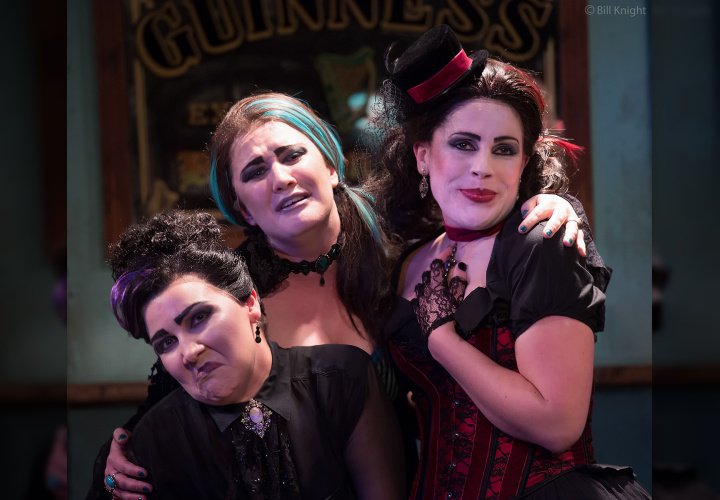
There are a few problems with this show, though. There is a quartet of women who sit on stage, busy at various pursuits, almost continuously, occasionally singing. They are oddly dressed – one is a knight, another a Bohemian artist-type and the other two in 1920s-style slinky cocktail frocks. I spent much of the 2 hours and 50 minutes (including interval) of this show trying to puzzle out who exactly these women are and why they’re there.

And, good as the orchestra is, it occasionally overpowers the singers. There were times, for example, when I couldn’t hear Charlotte Badham. And there is a problem with accents – I suppose the cast has been directed to sound American. In fact it is not sustained and the odd word you hear pronounced other than in RP it sounds like Cornwall. Moreover the diction is often fuzzy. One really shouldn’t need surtitles for an opera sung in one’s own language but in this case you certainly do, so I was glad they were there.

There is, however, plenty to admire in Little Women and I hope Mr Adamo was pleased with it despite the flaws.

First published by Lark Reviews: https://www.larkreviews.co.uk/?p=6855

Show: Coram Boy

Society: Tower Theatre Company

Venue: Tower Theatre. 16 Northwold Road, London N16 7HR

Credits: By Jamila Gavin, adapted by Helen Edmundson with original music by Colin Guthrie.

Coram Boy

4 stars

Originally staged at National Theatre, Helen Edmundson’s adaptation of Jamila Gavin’s young adult novel is big-cast theatre on a grand scale. So how do you make it work in a small space without the Olivier Theatre’s revolve and other high tech facilities? With elegance, flair, black curtains, mini rostra and a great deal of creative imagination from director Simona Hughes is the answer. She shows that this fine play can work anywhere if you give it free rein.

And Colin Guthrie’s evocative, clever original music is a magnificent addition with its Handel references and use of dissonance to connote fear, anxiety or anger. Pre-recorded by a small orchestra and effectively “led” by an on-stage professional violinist (Kate Conway) it adds a huge amount of atmosphere and colour.

Coram Boy is a complicated story set in the eighteenth century. It touches variously on slavery, the murder of babies by the sinister “Coram Men”, the significance of Handel in London, sex trafficking of very young girls for prostitution abroad, inheritance, paedophilia, empowerment of women, the redemptive power of music and our old friend “Sua padre” aka an unexpected (although the audience knows) paternity revelation – among many other things.

In a strong, all-age cast, Matt Tylianakis stands out as the dastardly Otis ruthlessly murdering infants (one of whom is, poignantly named Mercy) that he’s paid to deliver to Coram Hospital in the first act, He is then reborn as an utterly evil, smooth-talking, wheeling and dealing nobleman in the second. Paul Graves gives us a warmly sustained performance as the troubled, traumatised, epileptic Meshak and Nia Woodward delights as the initially playful, but then abused, Toby. Frankie Roberts, playing the music-focused reluctant inheritor of a big Gloucestershire estate – and then his son – is feistily boyish. She sings with sweet, intense musicality too so we are persuaded that, yes, Mr Handel would be impressed.

There’s also some pleasing choral singing in this moving show because one of the plot strands has Handel (who was a Coram Hospital donor) rehearsing a performance of Messiah. The whole cast rendering of “Hallelujah” at the end, once justice has been done and love has prevailed is a wipe-your-eyes moment – one of the many high spots in this well paced, sensitive production.

First published by Sardines: https://www.sardinesmagazine.co.uk/review/coram-boy-2/

Show: Crazy For You

Society: Chichester Festival Theatre (professional)

Venue: FESTIVAL THEATRE, Chichester. Oaklands Way, Chichester PO19 6AP

Credits: Music & Lyrics by George Gershwin and Ira Gershwin. Book by Ken Ludwig. Co-conception by Ken Ludwig and Mike Ockrent. Inspired by material by Guy Bolton and John McGowan

Crazy for You

4 stars

Chichester Festival Theatre. Photo: Johan Persson


Energy comes in many forms: physical, imaginative, musical, emotional, theatrical, choreographic. And this exuberant, happy, funny show packs them all. In spades.

The show itself – with its mistaken identity/disguise plot, about as plausible as Twelfth Night or Cosi fan Tutte – was new to me but of course it pounds along with very familiar Gershwin numbers such as Embraceable You and Naughty Baby. It’s actually a 1992 reworking (by Ken Ludwig) of an earlier show with additional Gershwin songs to push the plot. Susan Stroman, who directs this production, has long been a driving force in the show’s ongoing life.

In short, Bobby Child, engaged to a woman he doesn’t love, wants to be a dancer rather than running the family bank. So he escapes to Nevada where, after various plot twists, he helps to restore a derelict theatre and falls in love with the daughter of the owner. And they all lived happily ever after – or something.

Stroman’s choreography is glitteringly original. In I’ve Got Rhythm, the first act finale, for instance, she gives us something new to marvel at every few seconds in a scene which runs for nearly eight minutes. The ensemble groups, and regroups like a musical kaleidoscope. No wonder many press night audience members leapt  excitedly to their feet when it finished although we were only half way through the show.

She knows how to get the best – spectacularly so –  out of her accomplished cast too. Carly Anderson is terrific as Polly – she sings with passion and verve and dances in a whole range of styles. Tom Edden excels too as the Hungarian theatre impressario, Bela Zangler who eventually comes out to Nevada to see what’s going on. He has a lot of fun with this part and is very funny. And there’s a fabulous ensemble with lots of small roles, immaculately performed, in this fine show. There’s a lovely sequence with a double bass for instance – as much part of the choreography as the sound.

And as for Charlie Stemp as Bobby Child well, of course, he’s a show-stealer. His style lying somewhere between Tommy Steele and Fred Astaire spliced with his own magic, he oozes so much charisma and talent that he gets a round of applause simply for his first appearance on stage – like a grand old man of Theatrical Status. And yet he’s only 28 and it’s just six years since his first big show: Half a Sixpence at Chichester. It’s well deserved though. Bobby Child is a huge role. Stemp dances and dances – tap dancing on tables, leaping like Rudolph Nureyev, thowing Anderson and others into the air and much much more. And it’s all done with (apparently) effortless lightness and elegance. He’s a fine actor too bringing out all the humour of the situation when he disguises himself as Bela and confuses Polly. Then there’s his tuneful, nicely articulated singing. The term “star quality” might have been coined for Charlie Stemp.

You’d expect a 16-piece orchestra convened by Andy Barnwell to be strong and it is. Out of sight and under Alan Williams’s musical direction they make sure we hear every note and nuance of the score – and are happily on top of a wide range of styles.

Beowulf Borritt’s set is neatly, imaginatively supportive of the action. It takes us, without fuss, from Bela’s New York Theatre to a depression-hit Nevada town, suggested by tired looking  two storey brown buildings (with doors) which move in and out.

This is a magnificent show. Chichester has a strong track record of producing shows, particularly musicals, which then transfer into the West End. I shall be very surprised if this one doesn’t soon join the list.

First published by Sardines: https://www.sardinesmagazine.co.uk/review/crazy-for-you-4/

Show: Shrek: the Musical

Society: Cambridge Theatre Company

Venue: Great Hall at The Leys, Trumpington Road, Cambridge CB2 7AD

Credits: Music by Jeanine Tesori and book and lyrics by David Lindsay-Abaire. Based on the story and characters from the Oscar® winning DreamWorks Animation film.

Shrek: the Musical

4 stars

In the seven years since it was founded Cambridge Theatre Company has emerged as one of the strongest producers of amateur theatre in the country with lots of opportunities, at all levels, for learning, growth and development. This production of Shrek has a strong tradition to build on and, once again, does CTC great credit.

There’s a lot of Shrek about at the moment partly because the rights are available for amateur performance but also because it’s the perfect show for a non-pro company – lots of small cameo roles and plenty of scope for ensemble both children and adults. The tap dancing number with the rats, danced by children and adroitly choreographed by Gabriel Curteis is, for example, a highlight of this production.

It draws audiences, too, because most people know the film. And it’s subtly topical because at base this is a story about diversity, inclusion and the celebration of otherness: issues most of us think a great deal about these days. You can’t fault David Lindsay-Abaire’s witty book and lyrics too as we watch an initially surly ogre, the titular Shrek, and a large cast of fairytale or popular story characters all acting outrageously in character. Colleen McQuillen, for instance, is raucously present as Pinocchio, Damion Box floats about as the White Rabbit  and Gareth Mullan plays the Big Bad Wolf on stiletto-heeled boots.

Frances Sayer is outstanding as Princess Fiona waiting to be rescued in her tower and hiding an unusual (by fairytale standards) secret.  Scott Riley gets all the right Scots ruefulness as Shrek as he gradually falls in love with her and grows less grumpy, kinder and more willing to make friends – Riley gets the sense of change and wonder absolutely right. Mike Webster fizzes with energy as the talkative, tiresome (but observant) donkey who needs a friend – a fine, all singing all dancing performance. Rodger Lloyd is a joy as the ghastly Lord Farquaad, whom no self-respecting princess could possibly fancy, too. He leers, simpers and flips his false short legs around and has the audience in the palm of his hand.

Graham Brown’s eleven piece band, out of sight because the Great Hall has no orchestra pit, makes a pretty good fist of Jeanine Tesori’s wide ranging score although the balance isn’t always right and it occasionally overpowers the singing. I particularly like way Brown brings out the Grieg and Tchaikovsky quotes and gets lots of vibrance into I’m a Believer at the end.

Of course set, costumes and so on are hired in but I have to give the dragon a mention because, puppeted by three people with rods it comes in over the heads of the cast, eyes flashing and mouth working – great fun.

Well done, CTC. Another triumph. Keep up the variety.

First published by Sardines: https://www.sardinesmagazine.co.uk/review/shrek-the-musical-7/

Northanger Abbey was my O level set text and my introduction to Jane Austen. I was hooked.  I read the other five novels over the next couple of years including Persuasion which was part of the Bishop Otter College English course – much better than anything to do with teacher training which was what I was meant to be there for. Then, 20 years later, I studied Mansfield Park in some depth on my Open University degree course.

Northanger Abbey is different from the others because, as our rather pedestrian O level teacher who kept coyly referring to “Janeites” told us, it’s really a joke against the gothic novels which were very popular with young females at the time. With that in mind, Miss Vincent kept boring the pants off us by reading large chunks of Anne Radcliffe’s The Mysteries of Udolpho (1794), I think, with hindsight she was time-filling because she only had three texts to teach over a two year course. A more enlightened teacher might have spent the first year widening our literary horizons with, say, Keats, George Eliot, Larkin and the Brontes. But I digress.

Catherine Morland is a naïve 17 year old clergyman’s daughter who is taken to Bath for the social life by her flighty friend Isabella’s mother, Mrs Thorpe. Of course it’s all about meeting the right sort of chap in the Pump Rooms and Catherine soon encounters, and is very taken with, one Henry Tilney – definitely Mr Right. Miss Vincent kept telling us how very attractive he is which made us 15 year olds sneer pityingly behind her back.

The plot is complicated – with a lot of flirtation and nastiness along the way. Mrs Thorpe is one of Austen’s spitefully but accurately drawn, dim but dangerous social climbers. Cf Mrs Bennet in Pride and Prejudice and Mrs Norris in Mansfield Park. In time Henry invites Catherine to stay at his family home, Northanger Abbey, where she meets his delightful sister Eleanor who is a much better friend to Catherine than Isabella. Other memorable characters include Isabella’s ghastly brother John and the tyrannical General Tilney who mistakes Catherine for an heiress and sends her away when he realises the truth.

The best bit in the whole novel is Catherine’s first night  at the Abbey. She is very excited to be visiting a place which, obsessed with her favourite reading, she imagines to be full of gothic romance.  In her room is a “mysterious” chest  which surely must contain a vital letter or other document relating to something sinister or macabre? Austen wittily builds the tension up and up until Catherine opens the chest and finds – to her horrified delight –  a piece of paper.  It turns out to be a laundry list.

Of course it all works out in the end. Henry is a better man than his father and …. well, I won’t spoil the ending for you if you’re new to this novel. Suffice it to say that every Austen novel ends with wedding bells.

Although Northanger Abbey has never been as popular as some of the other Austen novels there have inevitably been dramatisations which fail to do it justice. The 1987 BBC version, for instance, starring Katharine Schlesinger as Catherine and Peter Firth as Henry lost all sense of Regency England although Robert Hardy was memorable as General Tilney. Then there was a film in 2007 with Felicity Jones as Catherine and JJ Feild as Henry. Good as Carey Mulligan was as Isabella I didn’t care for it much.

I read Northanger Abbey four or five times when I needed to know every detail for O Level. Returning to it 20 years later I was surprised how well I still knew it. And re-reading it now feels like visiting an old friend. Familiarity, however, does not blur the spiky wit and observation. This is Austen, after all, and I appreciate her more with every passing year.

Next week on Susan’s Bookshelves: Border Zone by John Agard

It blew me away when I first read it nearly twenty years ago. And rereading The Kite Runner now, the effect was the same. I finished it at 2.00am earlier this week because, once again, it got right under my skin. Putting it down and going to sleep was simply not an option.

Yes, I saw the film (2007) and there was a play version by Matthew Spangler in 2009 which has been variously revived. None of it came anywhere near the power of Khaled Hosseini’s novel Next year it opens on Broadway as a musical and I doubt that will be as mind blowing as the novel either – although of course I must, and shall, reserve judgement.

Like Hosseini himself, the narrator Amir is an Afghan, He grows up in prosperity with his widowed father cared for by two family servants, another father and son. Hassan is Amir’s best friend but their relationship fractures because of bullying, appalling behaviour by Amir (for which he tries to atone later in the novel) and, eventually war, The Taliban and displacement. But it’s a novel which, in a sense, comes full circle which is one of the reasons it’s such a moving, satisfying read.

The “sua padre” trick (I borrow the term from The Marriage of Figaro) aka an unexpected paternity revelation  is an old, old literary device. I used to brainstorm with students all the examples of it we could think of from TV dramas, to soaps, nineteenth century novels and Shakespeare. Nonetheless it can still work brilliantly and it does here. Suddenly the scales fall from Amir’s eyes and, perhaps from the reader’s although I had my suspicions all along, and suddenly everything in Amir’s childhood and his relationship with his father makes sense.

The Kite Runner

There’s another dimension to this fine, compelling novel too – an unintended one. The Americans invaded/relieved (or however you want to read it) Afghanistan in 1999. Either way they stopped Taliban rule and things gradually improved for ordinary people in terms of personal freedom, female education and so on. When The Kite Runner was written in 2003 it was a historical novel written from the perspective of better times. Then last year the US pulled out and the Taliban surged back to power meaning that life has, in many ways, returned to the 1990s as described by Hosseini. He and his compatriots (he lives in California now) must be close to despair. And it means that in 2022 you read the end of The Kite Runner thinking “Yes… but what now …?”

I read, with pleasure (and horror) Hosseini’s A Thousand Splendid Suns when it was published in 2008 but have failed to catch up with the rest of his oeuvre and he’s been quite prolific. I shall put that right over the next few months. There is, I gather, always an Afghan protagonist in his novels and that feels very timely just now.

Next week on Susan’s Bookshelves: Northanger Abbey by Jane Austen

Folkestone Symphony Diamond Anniversary Concert Leas Cliff Hall 09 July 2022

FOHS.jpgFolkestone Symphony’s postponed (the 60 year landmark was last year) Diamond Concert was worth waiting for and it was good to see a large audience in the grandiosity of Leas Cliff Hall to enjoy it.

The highlight of the evening was the Tchaikovsky violin concerto played by the charismatic, smiling Joo Yeon Sir. Her very first entry – as sumptuous and sensuous as I’ve ever heard it – was a love duet with the orchestra and she delivered the rest of the movement, including the fabulous harmonic-laden cadenza, with passion and precision which also shone through in the Canzonetta. There were some special moments during the mini duets with flute and then with bassoon when she turned to face the other players and we all felt the power of musical collaboration at its best. Her finale was shot through with so much rubato (and what fun she had with it) that Rupert Bond had to keep the orchestra alertly on its toes to follow her. All players came up trumps and the overall effect was to make a very well known work seem totally fresh. It was a bravura performance.

Folkestone Symphony is a community orchestra which states in its programme that it welcomes new members – at grade 6 standard for strings and grade 7 for woodwind and brass. So you don’t go expecting Berlin Phil quality. However there are some outstanding players in the ensemble and the string sound (an impressive nine first violins, eight seconds, six violas, eight cellos and four double basses) is a great strength. In the Enigma Variations which closed the concert I loved the way the contrasts and mood changes across the fourteen variations beamed out from the warmth of Variation 1 (it depicts the composer’s wife) through to the self-mocking pomposity of the final variation which presents the composer himself. Other noteworthy moments were Variation 7 with delightful timp work, variation 4 played with a vibrantly full sound and variation 8 which really emphasised the quintessentially English lyricism. And as for the famous Nimrod (variation 9) Bond took it at a tempo which moved dynamically so it didn’t feel, as it sometimes does, like an old fashioned gramophone in need of winding up.

And then we got an encore and were spirited away from Folkestone and the English Channel glinting through the windows to Vienna for the Radetsky March, played with aplomb and near-obligatory audience on the beat (sort of) clap along.

The concert had opened – nothing remotely obscure or modernist about this programme – with Brahms Academic Festival Overture which took the orchestra a few pages to settle into. Again, the strings excelled even in the fiendish scale passages on the final pa

ge but the overall cohesion slipped once or twice.

What a treat to attend a concert prefaced – presumably in honour of the Jubilee – with a fanfare and then the National Anthem. It isn’t easy to kick off cold with a fanfare but it came off reasonably well and I liked the arrangement of God Save the Queen.

First published by Lark Reviews https://www.larkreviews.co.uk/?p=6841

Show: DRACULA’S GUEST

Society: London (professional shows)

Venue: White Bear Theatre. 138 Kennington Park Road, London SE11 4DJ

Credits: Presented by Brother Wolf. Based on the works of Bram Stoker. Adapted, Produced and Directed by James Hyland. Performed by Ashton Spear and James Hyland. Music by Chris Warner

DRACULA’S GUEST

4 stars

Susan Elkin | 08 Jul 2022 23:46pm

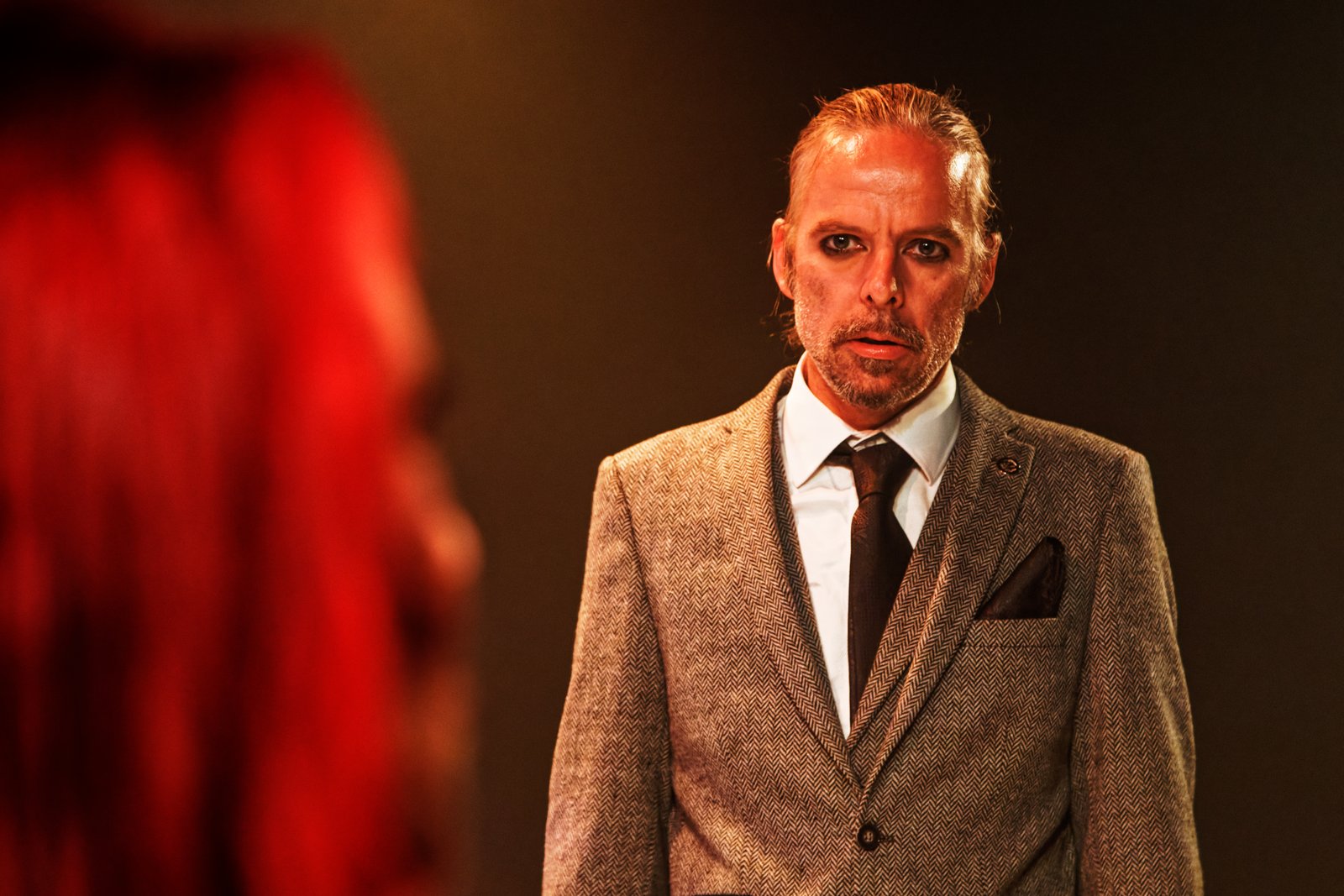
James Hyland is very good indeed at adapting classic texts and coming at them from a fresh point of view. I’ve seen him in at least three one-man takes on nineteenth century novels being both powerful and riveting. This time it’s a two hander, very focused adaptation with the excellent Ashton Spear as Renfield against Hyland’s own Count Dracula. At just sixty minutes it’s appropriately succinct. It would be hard to sustain (or to watch) such relentless intensity for much longer.

Bram Stoker’s famous 1897 novel is epistolary and, therefore set in various places. Hyland’s version is staged in one claustrophobic room in Dracula’s Castle in Transylvania with a minimalist set: two chairs, a table, a pig’s head and a sword – along with a menacing musical box.

Hyland is magnificent and terrifying. His voice ranges from soft cajoling to what a musician would call a subito fortissimo and he does it repeatedly so that neither you, the audience member, or Renfield within the play can relax for a second. He is a very dangerous man (or something) and the dramatic tension is sharply arresting. Somehow the fact that Hyland in this role looks like the then Prince of Wales (who became Edward VII four years after Dracula was published) makes it feel all the more shocking.  And although there’s nothing as corny or predictable as pointy teeth the scenes in which Dracula attacks Renfield fall somewhere between a hideous macabre dance and a rape.

The synergy between these two actors, as they spar around each other in what is effectively a power struggle, is what drives this fine show. Moreover I have rarely seen a more convincing account of on-stage insanity building to a manic climax than Spear’s work here. And the finale with fake blood is masterly. It could  easily degenerate into melodrama. In the event it’s horrifyingly realistic.

First published by Sardines: https://www.sardinesmagazine.co.uk/review/draculas-guest/