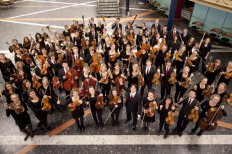
Stuttgart Philharmonic Orchestra
Conductor: Mariano Chiacchiarini
Piano: Alim Beisembayev
Cadogan Hall
23 November 2026
Zurich International Orchestra Series 2026-27
So what should a crack European Orchestra playing in London do for its encore? Brahms Hungarian Dance no 5 – obviously. It’s what they all do, well nine times out of ten anyway. It’s become such a cliché that it I chuckle when I see the music going onto the stands and wait for the familiar G minor opening to skip away sunnily. On this occasion of course Stuttgart Philharmonic played it with verve and Mariano Chiacchiarini delivered the swoops with exactly the right incisive affection.
He’s a pleasing conductor to watch – beating time neatly, using his left hand to signal entries or dynamics and resisting flamboyance. The sound he draws from the orchestra is rich, colourful and nicely balanced. He took the opening Hebrides Overture at a more modest tempo than some conductors which meant every detail was clear. The trumpet interjections were nicely marked, the clarinet solo beautiful and the storm suitably exciting.
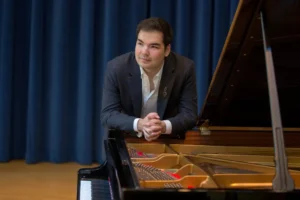
Then came one of the most operatic of Mozart’s 27 piano concertos: number 20 in D Minor K466 written in 1785 when he was in his late twenties as, coincidentally, is pianist Alim Beisembayev. Demonstrating warm rapport with Chiacchiarini, Beisembayev played it with understated eloquence and accomplished technique. The first movement cadenza, which ranges across the whole keyboard, was arresting and came with an exceptionally smooth pick up at the end. He played the Romanze with coherent delicacy and my goodness, how fine is bassoonist, Frnak Lehmann’s playing. He distinguished himself several times during this concert. Beisembayev and Chiacchiarini ensured that the Rondo rippled and sparkled to the end of the concerto.
Brahms’s Symphony no 3 (1883) is an introspective work and this thoughtful performance achieved the ranges of mood with aplomb – partly perhaps because Chicchiarini conducted it without score which meant that there was no barrier and he was effectively part of the orchestra with his smiles and straightforward gestures.
High spots in this rendering include the final note in the Andante in which outer string players played the harmonic and inner ones proved vibrato – a practice I’ve never noticed before and it was resoundingly effective. There was an aching plaintive quality in the Poco allegretto. Chiacchiarini took the final Allegro at a quite a speed – definitely the vivace end of the allegro spectrum – along with plenty of energy and close attention to dynamics. The pianissimo filigree string playing down the last page was lovely.
And then – of course, what else? – it was time for that Hungarian Dance which made sure we sang, and even danced a little, all the way home.