I made a recent promise to myself, and to readers of this blog, that I would read some George Moore. So I have. He was born in Ireland in 1852 and died in London in 1933 – a near contemporary of Thomas Hardy (1840-1928). Moore was 42 when Esther Waters was published in 1894, the same year as Trilby and The Prisoner of Zenda. Hardy’s final novel Jude the Obscure began as a magazine serial in the December of that same year.
Esther is a feisty working-class girl in service who takes a job in a big house funded by horse racing. Moore came from landed gentry so it’s a a world he evidently knows well although this third person narrative is told almost entirely from Esther’s point of view. Her family are Brethren – a strict non-conformist sect – so she embarks on adult life with very strong religious conviction although things happen to her which dent, and later destroy, this.
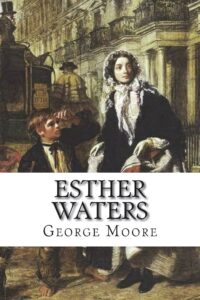
Yes, Esther Waters fits the theory that the whole of literature rests on seven stories and variations on them. It’s a rags to riches tale. Esther starts with nothing. Eventually after many years of struggle she finds modest prosperity which then, through no fault of her own, ebbs away from her. The structure is cyclical because it ends with Esther more or less where she started, having found her own version of peace.
Moore explores (exposes?) the horrors of horse racing with conviction. You might make a lot of money if you breed crack race horses and sell them. Otherwise it’s a loser’s game. Even bookmakers (and the novel reminds us that in 1894 betting was legal only at race courses and definitely not in pubs) often lose. And gamblers almost inevitably do because, almost by definition, they never know when to stop. It can never be a reliable source of income at any level.
He is also good on the relationship between servants and their employers which was changing by the late nineteenth century. Esther and Mrs Barfield respect each other (partly because the older woman is also a member of the Brethren) although the hypocrisy when Esther finds herself in serious trouble is extraordinary by modern standards. She is given money, and sympathised with, but sacked.
Also in the mix are the confused sexual politics of the 1890s, 70 years or so before the pill and the so-called sexual revolution. Although this is a naturalistic novel focusing on servants who were ignored by most novelists even 25 years earlier, it remains a Nineteenth Century Novel (my caps). As soon as Esther capitulates – delicately conveyed of course – to her beau, William, the outcome is obvious and inevitable.
William, however, is an interesting and complex character. Initially he behaves appallingly but ultimately redeems himself although he’s flawed by the horse racing obsession and eventually by failing health. In EM Forster’s terms (Aspects of the Novel, 1927) he’s very much a rounded character rather than a flat one.
Esther Waters – which is readable and entertaining – also presents friendship rather well. Moore certainly understood the need, particularly for women, of friends to support when the going gets really rough.
Give it a try if you don’t know Moore’s work.
Next week on Susan’s Bookshelves: Wilt by Tom Sharpe