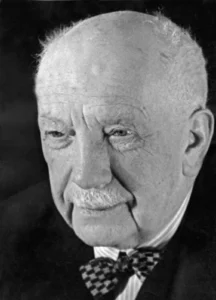
Santtu conducts a Strauss Extavaganza
Philharmonia
Conductor: Santtu-Matias Rouvali
Piano: Benjamin Grosvenor
Royal Festival Hall
Thursday 04 June 2026
This concert was billed as an exact re-run of the one the elderly Richard Strauss programmed and conducted with the Philharmonia, then just two years old, at Royal Albert Hall in 1947. In the event Rouvali changed the running order at the eleventh hour. It therefore acted as a finale to Philharmonia’s 80th anniversary year and acknowledged the link with Strauss who died in 1949 with a nod to the Festival of Britian which, 75 years ago saw the birth of Royal Festival Hall. All this was explained at some length, and rather unnecessarily, to the audience by trombonist James Buckle who is president of the Philharmonia Board and Thorben Dittes, Philharmonia Ltd’s CEO – despite its all being set out in the free programme.
The concert comprised four substantial works – all written before the composer was 50 including two (Don Juan and Burlesque in D Minor for Piano and Orchestra) dating from his twenties. And it ranged over many moods from the narrative sauciness of Don Juan, the witty, quasi piano concerto, the poignancy of the Der Rosenkavalier big tunes and the happiness of Symphonia Domestica.
The 1885/6 Burleske, the nearest Strauss ever got to a piano concerto, has a timpani opening wth echoes of Beethoven’s violin concerto or the second movement of the Choral Symphony and in this performance the duetting between timp (Ziv Stein) and Benjamin Grosvenor on piano was a delight. Also very beautiful here was the lyrical cadenza with cello (Richard Birchall). Did Strauss write this in homage to Clara Schumann whose piano concerto does something similar? Grosvenor, as usual, played with unshowy passion.
Otherwise highlights in this concert included fine oboe playing over muted strings in Don Juan and Rouvali’s carefully managed luxuriant and extravagant tempo changes in the Waltzes from Der Rosenkavalier.
The concert ended with Symphonia Domestica – a work which doesn’t get out much. And it’s unusual because the title says it all. It’s a description, composed when Strauss was 39, of his very happy family life, written in five movements without breaks. There was a lot of joy in this performance including the flute and clarinet weaving round each other in the adagio and some lovely work by the four bassoons.
This grandiloquent concert required huge forces on stage – at times there were eight horns, a quartet of saxophones, two harps and five percussionists so it felt richly celebratory. On balance though, for a 2026 audience there was one piece too many. It could have done with dropping either Don Juan or Der Rosenkavalier.
Listening to all that Stauss in one go, however, I’m struck – not for the first time – by the innovative brilliance of his orchestration and by his love of solo violin breaking out of the texture. Leader Zsolt-Tihamer Visontay had extra work to do in all four pieces – all played in his unique, straight-backed style and lots of eye contact with the orchestra. And, as always with the Philharmonia, there was a palpable rapport between string sections which contributes to the precision of the orchestra’s distinctive sound.