Press ESC or click the X to close this window

Susan Elkin reviews: This Beautiful Future

Show: This Beautiful Future

Society: West End & Fringe

Venue: Jermyn Street Theatre. 16b Jermyn Street, London SW1Y 6ST

Credits: BY RITA KALNEJAIS. DIRECTED BY CHIROLLES KHALIL.

Type: Sardines

Author: Susan Elkin

Performence Date: 20/08/2021

This Beautiful Future

Susan Elkin | 21 Aug 2021 22:56pm

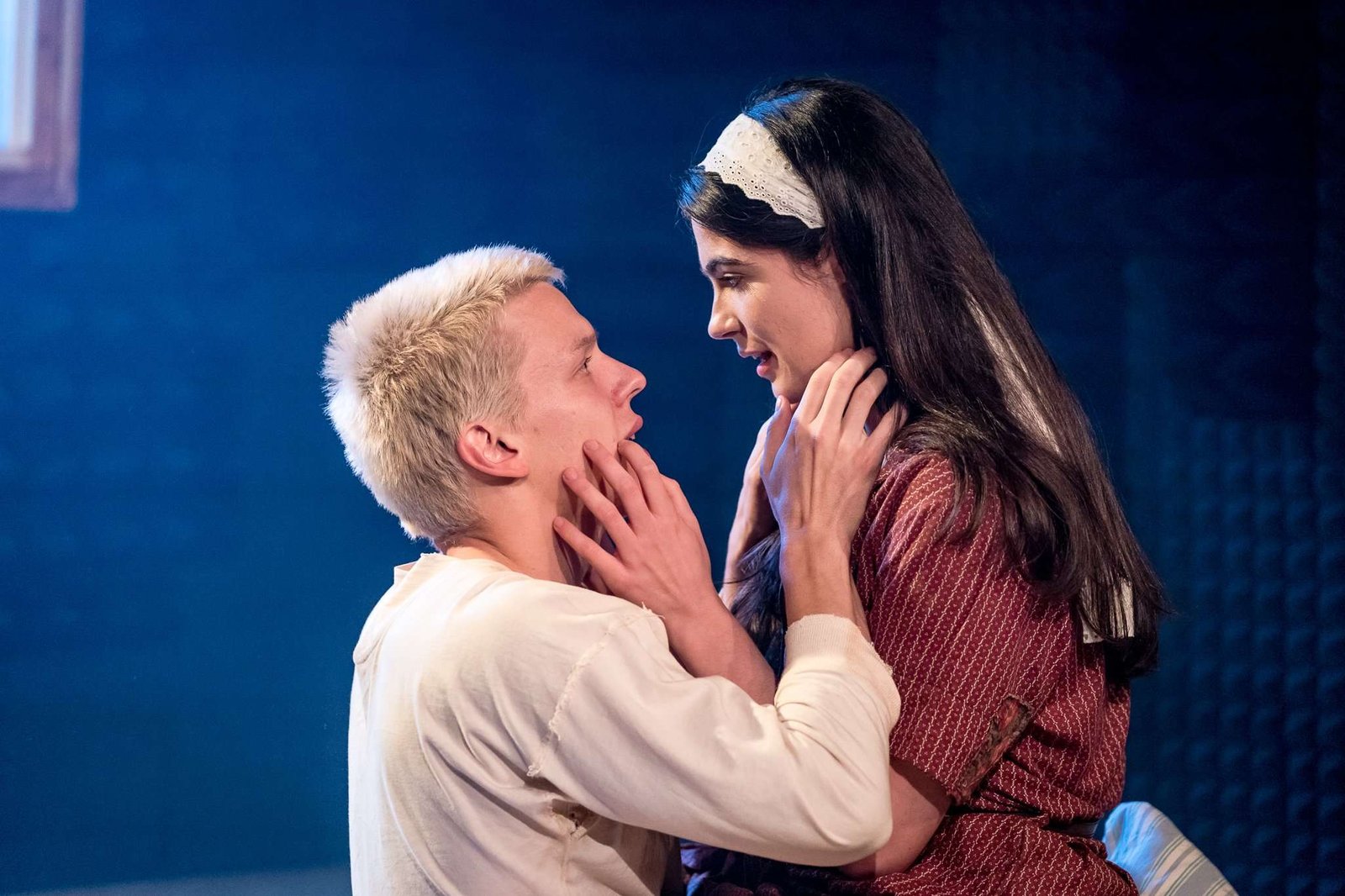
Photo: Steve Gregson


The story of young love thwarted by circumstances is a well worn path with landmarks such as Orpheus and Eurydice, Tristan and Isolde, Abelard and Heloise and, of course, Romeo and Juliet. This time we’re in Chartres at the end of the Second World War for a two-hander in which a German boy and a French girl are clandestinely enjoying each other’s company. It’s very sweet with a lot of charm and wit but it also packs quite a gutsy punch because of course it can’t end well – although playwright Rita Kalnejais gives us alternatives to ponder.

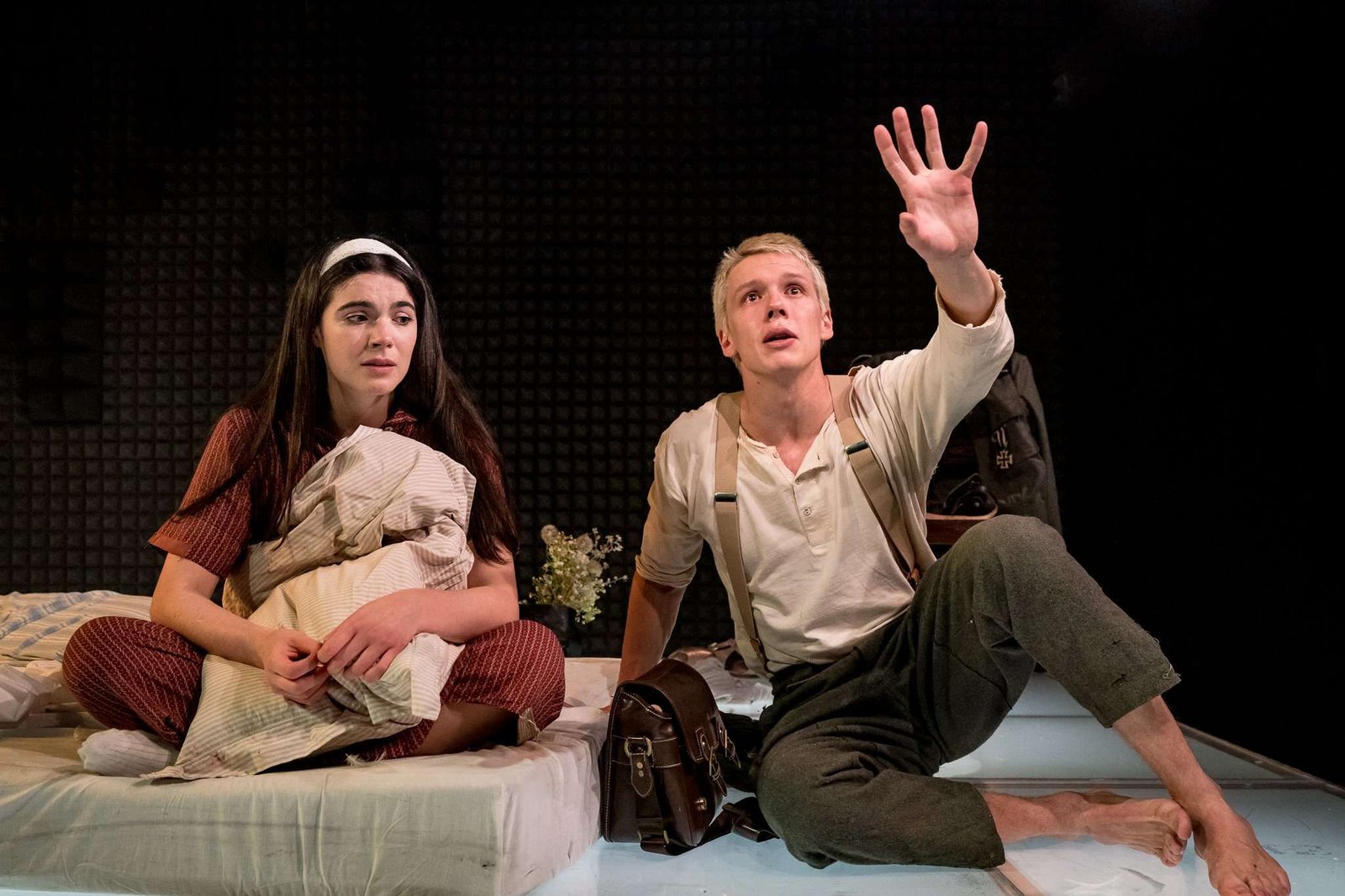
Otto (Freddie Wise) and Elodie (Katie Eldred) meet in a room in a house abandoned by a Jewish family – an irony because although Elodie knew and respected Mrs Levy, Otto idolises “Mr Hitler” and believes that the future with a “clean” nation of Germans looks wonderful. Another irony is that Germany has already lost the war. The D day landings have happened and the Americans are in Paris but deluded, indoctrinated Otto is convinced that he will be part of the force to march into Britain the next day, During the night that Otto and Elodie spend together, Katy Hurstwick’s sound design provides Lancasters overhead and a lot of menace – all outside the cocoon that the lovers are in – with the egg she has rescued and is incubating in his cap because chicks are a symbol of new life and hope.

Under Chirolles Khalil’s direction Wise and Elded work exceptionally well together. They have mastered the use of awkward, evocative silences for example and there’s a great deal of wordless communication – sometimes funny, often poignant and always effective. Eldred makes Elodie fresh, truthful and yearning – her character’s epilepsy, notwithstanding. It is very clear why Otto is so taken with her despite her being, effectively, on the “wrong” side. Wise (hair dyed blond to make him look more stereotypically German) brings a tragic vulnerability to Otto. He is really only a boy doing what he’s told and believing what those who’ve trained him have told him. Both actors are Drama Centre graduates (Eldred in 2018 and Wise in 2017) and clearly ones to watch.

Jermyn Street Theatre – almost at full capacity on press night – is the smallest producing house in London and it’s good to see it in good form, punching well above its weight again after all the problems of the last 18 months.

This review was first published by Sardines: https://www.sardinesmagazine.co.uk/review/this-beautiful-future/

Henrietta – National Youth Music Theatre

Picture: Konrad Bartelski

Henrietta, presented by National Youth Music Theatre, continues at The MCT at Alleyn’s, London until 21 August 2021.

Star rating: four stars ★ ★ ★ ★ ✩

Commissioned from Alex Parker and Katie Lam by NYMT for last year but, perforce, postponed until now Henrietta is a good piece for a youth organisation.

NYMT works with young people from age 10-23 which means there are children to play the juvenile roles along with competent performers in their early twenties able to play adults in their thirties and beyond with conviction.

It’s Amsterdam in 1944. Some Jews are in hiding, some people are trying to help them while others – we’re in the heart of the community with people who’ve known each other all their lives – agree with occupying Nazi policy or seem to.

And at the centre of all this meaty tale is a sparky child (role shared between Charlie Herlihy and Ellie Jones across different performances) who wants to be a hero and whose origins suddenly turn out to be not quite what she has been brought up to believe …

Read the rest of this review at Musical Theatre Review: https://musicaltheatrereview.com/henrietta-national-youth-music-theatre/

Carousel – Open Air Theatre Regent’s Park

Picture: Johan Persson

Carousel continues at the Open Air Theatre Regent’s Park until 25 September 2021.

Star rating: four stars ★ ★ ★ ★ ✩

Rodgers and Hammerstein never sidestepped a gritty issue and their 1945 piece about domestic abuse is no exception – and could hardly, given how cases have risen during lockdowns, be more topical.

Yes, there are some very familiar good tunes in Carousel but there is also a great deal of profoundly shocking stuff – the audience gasped in horror more than once on press night – to make anyone who sees it think long and hard.

Of course the original, based on a short story by Ferenc Molnar, was set on the coast of New England. In Timothy Sheader’s thoughtful production we’re in the north of England and the cast members use their own accents, giving a rich variety and stressing the piece’s universality. The American references in the text don’t matter much either. It’s like seeing Julius Caesar set in a modern state. Your brain just accepts the relevance and allows for minor discrepancies …

Read the rest of this review at Musical Theatre Review: https://musicaltheatrereview.com/carousel-open-air-theatre-regents-park/


BBC Prom- Aurora Orchestra Nicholas Collon 11th August

Full biography - Aurora OrchestraEverything in this concert was beautifully played. First we had a warm, intelligent account of Rachmaninov’s Rhapsody on a Theme of Paganini with Pavel Kolesnikov at the piano. Each and every one of the 24 variations was spelled out with sensitive attention to all those different styles especially in the pizzicato variation and the frenetic finale.

Then, eventually, we got magnificent performance of Firebird with every nuance lovingly leaned on. Because this is Aurora Orchestra (founded by Nicholas Collon in 2005) most of the players stood up for both works and the Stravinsky was played from memory which meant that players maintained continuous eye contact with the conductor and each other and that introduces a very unusual level of cohesion. Of course this is a narrative piece – it’s ballet music after all – and I have rarely heard the story telling so clear or so well articulated. The moment in this performance when the horn breaks in with that final haunting hymn-like tune will stay with me for a long time because Collon made it grow from the previous pianissimo passage like a flower bursting into bloom. The low level attempt at “staging” by altering the lighting, added nothing though. There was enough drama in the music. It needed no highlighting.

Having said all that though there were problems – at least as far I was concerned. The concert was introduced by Tom Service on stage. Now although I listen regularly to his informative Radio 3 programme The Listening Service and admire his fluent, knowledgeable enthusiasm, I don’t need Mr Service to tell me what I’m going to hear or to whip up applause with arm gestures like a pantomime character. I go to concerts for the music and really don’t care for any sort of chat in that context.

Moreover, In the middle of this concert we got a 20 minute musicology/music appreciation lesson – the sort of thing I associate with concerts for young audiences. It was well enough done in its way although I don’t relish being asked to hum. Service and Collon are an effective double act and Collon talked about Stravinsky’s use of intervals, illustrated by Aurora players quite interestingly. Orchestra members even sang a couple of songs which are part of the source material for Firebird. But you can get this sort of thing on the radio if you want it. In a concert hall I want music and in this case I would much preferred to have heard an extra work.

I also found myself irritated that in a concert billed as “no interval” audience members had to talk among themselves for 10 minutes while music stands and piano were taken off stage and various other bits of stage management were attended to. Several people, puzzled, tried to slip out and were turned back by staff.

It was, however, a good idea to run this concert twice. I attended the afternoon performance as part of a good sized audience. It was the later, evening performance which went out live on Radio 3.

This review was first published by Lark Reviews: https://www.larkreviews.co.uk/?p=6586

BBC Prom: Scottish Symphony Orchestra. Martyn Brabbins 6th August 2021

It was interesting programming – and apparently unprecedented at the Proms – to pair Pergolesi and Stravinsky as a way of highlighting the influence of the former on the latter. Of course we now know that the direct source material for Pulcinella came from his early eighteenth century contemporise rather than from Pergolesi himself but the influence is clear for all that.

We began with an exquisitely moving account of Pegolesi’s Stabat Mater with the blending of voices – Carolyn Sampson, soprano and Tim Mead, counter-tenor – so subtle that at times it sounded like a single person miraculously able to sing two lines. The crystalline, vibrato-free purity was magical too. Then there was the Quae moerebat in which Mead and the orchestra duetted with subtle sensitivity like a baton being passed back and forth. The final Quando corpus morietur – the ultimate moment in a mother’s anguish for her son – was an edge-of-seat, lump-in-throat moment and it’s just as well that Pergolesi provides a relatively jolly Amen after it or the very well deserved applause would have felt inappropriate.

Brabbins (a short notice substitute for Joana Carneiro) is an unassuming conductor and a safe pair of hands in the best possible sense. He knows exactly how to deliver this gorgeous quasi-operatic eighteenth century stuff with all its colourfulness, variety and precision. He beats time unashamedly and the cohesion was spot on.

Then after the interval came a real change of mood – marked even before it started by the entrance of Carolyn Sampson in scarlet dress with glittery jewellery rather than the simple sober black she’d worn for the first half. The original 1919/20 version of Pulcinella was a hybrid “ballet in one act with song” and this is what was performed at this concert although many of us may be more familiar with the shorter orchestral suite which Stravinsky arranged later in 1920.

Sampson was joined by tenor Benjamin Hulett and bass Simon Shibambu all of whom did a good job especially in the Andante when the three come together as in an opera by, say, Mozart until the tenor leads off into some unlikely harmonies before his challenging patter song – all delivered by Hulett with warmth.

I also admired the verve of all that off-beat pizzicato scrupulously played by SSO and stressed by Brabbins as the winds deliver their many solos in this sparky narrative tale of skulduggery and love told in a series of reworked eighteenth century. And the dramatic jazzy trombone solo is always fun. The unexpected glissandi rang out with wit, thanks to principal trombonist, Simon Johnson who earned his moment of individual applause at the end.

This review was first published by Lark Reviews: https://www.larkreviews.co.uk/?p=6579

BBC Prom – Royal Philharmonic Orchestra Vasily Petrenko- 4th August

Vasily Petrenko | IMG Artists

Reshaping was the theme of this concert: Ralph Vaughan Williams reinventing Thomas Tallis, Respighi constructing a concerto based on plainchant and Mendelssohn responding to the Reformation, complete with protestant chorale. And it was noteworthy for another reason: Vasily Petrenko is RPO’s new Principal Conductor and this was his first concert in that role although he has, of course, conducted RPO many times before.

The opening Fantasia on a Theme by Thomas Tallis was glorious. The Royal Albert Hall acoustic and the distancing of the nine piece chamber orchestra on a higher level at the back ensured that every note and cadence sang with all the required wistful poignance. The musical rapport between them, the main orchestra and the string quartet at its heart ensured that we heard nuances that no recording ever captures.

Ottorino Respighi’s 1921 Concerto Gregoriano was new to me – and I expect to most of the audience. It gets few outings and this was its first performance at the Proms. It was also a Proms debut for diminutive Japanese violinist Sayaka Shoji who is 38 but looks two decades younger. It’s a substantial, ambitious work, often modal and inspired by Gregorian chant. Maybe Respighi tried to pack too much in because it feels pretty indigestible. Perhaps he should have taken the reshaping even further and made it into two concerti. Nonetheless Shoji seemed to play it with aplomb although I have no other performances to compare it with. I liked her beautiful sostenuto double stopping in the Andante and the intriguing passages in the finale when violin and timpani were centre stage (put me in mind of the much later Patricia Kopatchinskaja cadenza for the Beethoven concerto) and another nice bit with horns.

Mendelssohn’s D major symphony, ‘Reformation’ has never quite achieved the popularity of his earlier ones which is a pity because there are some splendid things in it – although it is arguably the most disjointed of Mendelssohn’s first five symphonies. Under Petrenko’s strange, fluid (is he double jointed?), octopus-like finger waving control the chorale ‘Ein feste Burg ist unser Gott’ was a delight and principal flautist Emer McDonough certainly deserved the applause Petrenko directed her way at the end. There was pleasing lightness from the woodwind in the Allegro vivace and admirable clarity and cohesion from the strings in the Andante. We got a deal of warmth and excitement too partly because of Petrenko’s ability to create – almost choreograph – the quietest possible piano and pianissimo passages.

This review was first published by Lark Reviews https://www.larkreviews.co.uk/?p=6575

OK, let’s get it out of the way. Kipling was an imperialist. He was also a fine story teller and poet. I am firmly convinced that you have to separate the creator from the art. I don’t refuse to listen to Wagner because he inspired the Nazis or to Gesualdo’s madrigals because he killed his wife. Neither do I reject the beauty of Eric Gill’s art (over the door at Broadcasting House, for instance) because of the sculptor’s appalling abuse of his daughters.

Many people – nurtured on what it is arguably the best animated film Disney has ever made, immortalised by George Bruns’s wonderful score and songs by Terry Gilkyson and the Sherman brothers – don’t realise that The Jungle Book (1894) is a collection of short stories (and seven related poems). The first three stories are about Mowgli and the other four are about something else.

“Rikki-Tikki-Tavi”, for instance, is the powerful story of a mongoose who protects the (colonial) family, whose garden he lives in, from the malevolence of a pair of cobras. It’s colourful, exciting and rhythmic. Amazingly, considering how distant it was from every day experience in Kent,  it was one of the best read-aloud stories I ever found in 36 years of teaching English. Classes would tell each other about it and arrive at the lesson begging me to read to them “that story you read to 2M the other day”. Yes, Kipling knew how to tell a good story. “The White Seal” is a compelling tale, set in the Pacific.  Sadly “Toomai of the Elephants” focuses too much on beating animals into submission for my 21st century sensibilities and “Servants of the Queen” is a very strange story about hierarchy – including, and among, animals – in the British army in India.

Well, I hadn’t opened The Jungle Book for some years until now and am amused to discover that the battered old copy which has been around for as long as I can remember (was it my father’s?) is dated 1895 and illustrated by Kipling’s only son John who died in WW1 and two others.  The Mowgli stories were plundered by Robert Baden Powell, with permission from his friend Rudyard Kipling, for the nomenclature for his junior scout movement in 1916 – hence “cubs”, “Akela”, “the grand howl” and so on although a lot of that has been toned down in the UK in recent years. In many ways those stories, courtesy of both Baden Powell and Disney (whose interpretation was … err … loose) have bedded down to become an established part of our culture whatever we think about Kipling’s imperialism.

So how do they read now? Well, the use of a clumsy form of 16th century English (“Art thou hurt”?) to denote a language which is not English whether spoken by animals or humans, seems unbearably twee now. I hope newer editions, now that Kipling is long out of copyright, edit this out. The anthropomorphism sometimes grates too because it’s inconsistent. Yes, animals care for their young, hunt to eat and so on but they don’t conduct carefully orchestrated vendettas, lay plans or strike bargains. And the idea of Shere Khan, the tiger, being the baddie simply because he’s at the top of the food chain doesn’t sit right in 2021. He ends up skinned too which is positively repugnant in an age when thinking people are doing all they can to protect tigers.

And yet …Kipling keeps you turning the pages. You have to know what happens because he makes you care.  His characters have dignity – and that’s very welcome, however unfashionable it is. The stories also celebrate qualities like loyalty and friendship. Occasionally his arresting use of language leaps joyfully off the page: Bagheera hurrying at a “panther-canter” or someone waking to “blinding warm rain” for example.   Moreover in a story like “Rikki-Tikki-Tavi” there’s a thriller element, carefully psyched up by a man who knew exactly what he was doing.

Yes, The Jungle Book is worth a reread as long as you make allowances for a totally different culture – historical, social and political.
 Jungle BookNext week on Susan’s Bookshelves: Fingersmith by Sarah Waters
I try to read eclectically although there are some genres (horror, science fiction and fantasy for example) that I really don’t like. I can’t really be doing with anything too horrifically violent either. Of the ten books or so I read each month I suppose roughly one third is new fiction, including a young adult one occasionally. A second third is re-reads, usually of trusty old favourites some of them written centuries ago.  And the rest are crime fiction – my bolt hole for switching off. I also take in the odd non-fiction book.

And short stories are good occasionally because you can dip in and out.

I’ve gobbled up all Peter James’s Roy Grace crime novels and some of his standalones so I was curious to see what his short stories were like. The answer is: varied. The selection which makes up The Twist of the Knife have obviously been written at different times – some decades ago and others quite recent. And they certainly reflect the themes and things which James is preoccupied with. For example, in no particular order: prestige watches, dating agencies, sailing and the supernatural. These, and other interests, crop up repeatedly.

Fascinating, though to read the short story which he wrote years ago about a man buried alive in a stag night prank. Later James realised that this idea has more potential than he had exploited in a short story and he used it as the main plot line in the opening novel in the Roy Grace series. Clearly a good decision.

I also liked the macabre account of a woman whose loving and beloved husband dies on their yacht in mid ocean. It takes her two weeks to get it solo to Sri Lanka where she makes an unexpected life-changing discovery. Then there’s the true story about a wealthy Italian woman who smuggled some impressionist paintings to America. We also get Roy Grace as young copper on his first case and, in another story, a sort of Roy Grace Christmas special. Some stories are very short. Others are more detailed. Most feature quite nasty people getting their comeuppance, one way or another. Just deserts – very satisfying.

At the same time I’ve been reading Chekhov short stories upstairs in my screen-free bedroom. I salvaged Lady with Lapdog and Other Stories, translated by David Magarshack from my neighbour’s on street help-yourself pile after she’d had a clearout.

They’re (a bit!) different from Peter James as you’d expect but often it’s still a case of amoral people hitting the buffers. I learned recently from Michael Pennington’s one man show Anton Chekhov that the Russian playwright wrote over 600 short stories, mainly to pay the bills. Of course I know his drama but until now the stories had passed me by. They too are good to visit without the need to read them all at once if you don’t want to.

Next week on Susan’s Bookshelves: The Jungle Book by Rudyard Kipling