Press ESC or click the X to close this window

Susan’s Bookshelves: The Jungle Book by Rudyard Kipling

OK, let’s get it out of the way. Kipling was an imperialist. He was also a fine story teller and poet. I am firmly convinced that you have to separate the creator from the art. I don’t refuse to listen to Wagner because he inspired the Nazis or to Gesualdo’s madrigals because he killed his wife. Neither do I reject the beauty of Eric Gill’s art (over the door at Broadcasting House, for instance) because of the sculptor’s appalling abuse of his daughters.

Many people – nurtured on what it is arguably the best animated film Disney has ever made, immortalised by George Bruns’s wonderful score and songs by Terry Gilkyson and the Sherman brothers – don’t realise that The Jungle Book (1894) is a collection of short stories (and seven related poems). The first three stories are about Mowgli and the other four are about something else.

“Rikki-Tikki-Tavi”, for instance, is the powerful story of a mongoose who protects the (colonial) family, whose garden he lives in, from the malevolence of a pair of cobras. It’s colourful, exciting and rhythmic. Amazingly, considering how distant it was from every day experience in Kent,  it was one of the best read-aloud stories I ever found in 36 years of teaching English. Classes would tell each other about it and arrive at the lesson begging me to read to them “that story you read to 2M the other day”. Yes, Kipling knew how to tell a good story. “The White Seal” is a compelling tale, set in the Pacific.  Sadly “Toomai of the Elephants” focuses too much on beating animals into submission for my 21st century sensibilities and “Servants of the Queen” is a very strange story about hierarchy – including, and among, animals – in the British army in India.

Well, I hadn’t opened The Jungle Book for some years until now and am amused to discover that the battered old copy which has been around for as long as I can remember (was it my father’s?) is dated 1895 and illustrated by Kipling’s only son John who died in WW1 and two others.  The Mowgli stories were plundered by Robert Baden Powell, with permission from his friend Rudyard Kipling, for the nomenclature for his junior scout movement in 1916 – hence “cubs”, “Akela”, “the grand howl” and so on although a lot of that has been toned down in the UK in recent years. In many ways those stories, courtesy of both Baden Powell and Disney (whose interpretation was … err … loose) have bedded down to become an established part of our culture whatever we think about Kipling’s imperialism.

So how do they read now? Well, the use of a clumsy form of 16th century English (“Art thou hurt”?) to denote a language which is not English whether spoken by animals or humans, seems unbearably twee now. I hope newer editions, now that Kipling is long out of copyright, edit this out. The anthropomorphism sometimes grates too because it’s inconsistent. Yes, animals care for their young, hunt to eat and so on but they don’t conduct carefully orchestrated vendettas, lay plans or strike bargains. And the idea of Shere Khan, the tiger, being the baddie simply because he’s at the top of the food chain doesn’t sit right in 2021. He ends up skinned too which is positively repugnant in an age when thinking people are doing all they can to protect tigers.

And yet …Kipling keeps you turning the pages. You have to know what happens because he makes you care.  His characters have dignity – and that’s very welcome, however unfashionable it is. The stories also celebrate qualities like loyalty and friendship. Occasionally his arresting use of language leaps joyfully off the page: Bagheera hurrying at a “panther-canter” or someone waking to “blinding warm rain” for example.   Moreover in a story like “Rikki-Tikki-Tavi” there’s a thriller element, carefully psyched up by a man who knew exactly what he was doing.

Yes, The Jungle Book is worth a reread as long as you make allowances for a totally different culture – historical, social and political.

 Jungle BookNext week on Susan’s Bookshelves: Fingersmith by Sarah Waters

I try to read eclectically although there are some genres (horror, science fiction and fantasy for example) that I really don’t like. I can’t really be doing with anything too horrifically violent either. Of the ten books or so I read each month I suppose roughly one third is new fiction, including a young adult one occasionally. A second third is re-reads, usually of trusty old favourites some of them written centuries ago.  And the rest are crime fiction – my bolt hole for switching off. I also take in the odd non-fiction book.

And short stories are good occasionally because you can dip in and out.

I’ve gobbled up all Peter James’s Roy Grace crime novels and some of his standalones so I was curious to see what his short stories were like. The answer is: varied. The selection which makes up The Twist of the Knife have obviously been written at different times – some decades ago and others quite recent. And they certainly reflect the themes and things which James is preoccupied with. For example, in no particular order: prestige watches, dating agencies, sailing and the supernatural. These, and other interests, crop up repeatedly.

Fascinating, though to read the short story which he wrote years ago about a man buried alive in a stag night prank. Later James realised that this idea has more potential than he had exploited in a short story and he used it as the main plot line in the opening novel in the Roy Grace series. Clearly a good decision.

I also liked the macabre account of a woman whose loving and beloved husband dies on their yacht in mid ocean. It takes her two weeks to get it solo to Sri Lanka where she makes an unexpected life-changing discovery. Then there’s the true story about a wealthy Italian woman who smuggled some impressionist paintings to America. We also get Roy Grace as young copper on his first case and, in another story, a sort of Roy Grace Christmas special. Some stories are very short. Others are more detailed. Most feature quite nasty people getting their comeuppance, one way or another. Just deserts – very satisfying.

At the same time I’ve been reading Chekhov short stories upstairs in my screen-free bedroom. I salvaged Lady with Lapdog and Other Stories, translated by David Magarshack from my neighbour’s on street help-yourself pile after she’d had a clearout.

They’re (a bit!) different from Peter James as you’d expect but often it’s still a case of amoral people hitting the buffers. I learned recently from Michael Pennington’s one man show Anton Chekhov that the Russian playwright wrote over 600 short stories, mainly to pay the bills. Of course I know his drama but until now the stories had passed me by. They too are good to visit without the need to read them all at once if you don’t want to.

Next week on Susan’s Bookshelves: The Jungle Book by Rudyard Kipling


Show: Around the World In Eighty Days

Society: Spontaneous Productions

Venue: The Bowling Green, Mayow Park. Mayow Road, London

Credits: Adapted by Jonathan Kaufman and Jane Walker from the book by Jules Verne. Original songs and music by Paul Tornbohm. Presented by Spontaneous Productions in association with KIRKDALE BOOKSHOP.

Type: Sardines

Author: Susan Elkin

Performence Date: 03/08/2021

Around the World in Eighty Days

Susan Elkin | 03 Aug 2021 23:09pm

In all honesty I don’t expect to walk a mile from my south London home and find a 5-star show in a local park. But a five-star rating means one of the best examples of a show of its type that the reviewer has ever seen – and that’s precisely what this is. Complete with sparky plot, imaginative promenade staging, a four-piece live band, gentle inclusion of topical issues and a show case for the skills of five fine, immaculately directed actors, it is an outstanding piece of work.

Loosely based (adapted by Jonathan Kaufman, who also directs, and Jane Walker) on Jules Verne’s 1873 novel this version of Around the World in Eighty Days gives us Phineas Fogg (Hjalmar Norden – excellent) taking a bet for £20,000 for his friends at the Reform Club and then setting off on his global circumnavigation with his servant Passepartout. In this show – stroke of genius –  Passpartout is played by the charismatic, Jimand Allotey and reworked as a very French woman in disguise fighting the establishment because she’s an inventor and wants to be recognised.   Once they reach India, of course there’s also a subtext about colonisation and tiger hunting – which is picked up again in California when they encounter the Navajo. It’s neatly done and seamless and feels absolutely right for now.

William Hastings delights in a whole raft of roles including the dim but determined Inspector Fix who thinks Fogg is a bank robber and pursues him. I also enjoyed his utterly ghastly tiger-shooting Cromarty. Lana Eyre plays Miss Lily, a Shanghai woman on the make, among other roles all with aplomb, and Deborah Chatterjee finds real dignity and humour in Rani, the Indian Queen who becomes Fogg’s love interest, as well as captaining a ship in trouble and being a suitably tiresome Hooray Henry at the Reform Club.

It’s a show full of strong staging ideas too. When Fogg and Passepartou cross the channel by balloon there’s a simple box they get into and walk it while the balloon is held aloft over the wall behind them. Similar witty ingenuity gets them across the Indian Ocean on a steamer and from San Francisco to New York by train.

The old bowling green in Mayow Park is a large square grassy space accessed by steps down and with a wide ledge (originally for spectators?)  – effectively an integral stage around its edge. This show is staged in four different parts of the green so that each site represents a place. On two corners are tents which act as “tiring houses” for all those quick changes.  You really couldn’t make better use of the space.

And as if that weren’t enough the four piece band Red, Hot and Blue are there sounding like the Temperance Seven (oh how  I love a farty sousaphone – bravo Marc Easener). They don different hats in different countries and play appropriate music such as “Those Magnificent Men in Their Flying Machines” for the Channel crossing,  “Nellie the Elephant” for a gorgeous two person pachyderm in India, “The Stars and Stripes” for arrival in the USA and so on. They also provide sound effects such as Big Ben in London or the train in the USA where they also form part of it. And trumpeter, Peter Leonard does a witty little mime appearance as Queen Victoria.

Yes, it’s a very special show. There are four more performances. Get there if you possibly can and take the family with you. It really does work for any age.

First published by Sardines: https://www.sardinesmagazine.co.uk/review/around-the-world-in-eighty-days/

Show: John and Jen

Society: Southwark Playhouse

Venue: Southwark Playhouse. 77-85 Newington Causeway, London

Credits: by Andrew Lippa and Tom Greenwald

Type: Sardines

Author: Susan Elkin

Performence Date: 02/08/2021

John and Jen

Susan Elkin | 03 Aug 2021 16:35pm

All photos: Danny Kaan


I may be prejudiced (all right – I am) but I was predisposed towards this show as soon as I saw the band: two violins, cello and keyboard – almost a classical quartet. I guessed we were in for something lyrical, thoughtful and human and I was right.

John and Jen is a two hander chamber musical dating from 1991 but composers, Andrew Lippa and Tom Greenwald worked with director Guy Retallack to update it for this production so the long time trajectory now ends in 2023. I don’t suppose that was difficult to do because the story and the issues are timeless. And although it is firmly set in America the messages are universal.

It’s a play in two very distinct halves. In the first John (Lewis Corney) and Jen (Rachel Tucker) are siblings growing up in a troubled, often abusive household. Jen, who is older does as much as she can to protect her little brother but it isn’t enough – she is, after all, a teenager with a life to lead.  By the interval she seems to have failed him.

But, in an unexpected twist (no spoilers) she then gets a second chance. Of course she tries so hard that she comes within a hair’s breadth of blowing it. Thus the whole piece is about family relationships, nurturing loved ones, respecting each other and letting go. So it speaks to every one of us.

Tucker is convincing at all stages of Jen’s life – whether she’s being a stroppy teenager or an overzealous middle aged woman. The music, which is often naturalistically sung dialogue rather than songs or numbers, suits her voice and we hear a wide range of registers. There’s a pretty spectacular full belt number in the second half which got a spontaneous round of applause on press night.

She and Corney have palpable chemistry between them. He finds a pleasing range of moods for John – good as trusting child, an anxious adolescent, a troubled young adult and there’s a hilarious baseball scene. I liked the way Lippa sometimes puts John’s tenor line higher than Jen’s mezzo one in duets – it changes the dynamic in their relationship at times.

And as for that band, yes they make a lovely sound in a pretty complex  score blending together attractively with music director  Chris Ma on keys. It’s a nice touch to have them in full view at the side of the stage.

John and Jen

BBC Prom: Scottish Symphony Orchestra, Maxim Emelyanychev- 1st Augus

Royal Albert Hall London - Theatre - visitlondon.comVery much a concert for discerning grown ups, this event presented Mozart’s last three symphonies as a triptych. It was imaginative programming which certainly highlighted new aspects of three very familiar 1788 works as well as linking them together – a journey, as it were, all the way from the Haydnesque slow E flat major introduction in number 39 to the glorious fugue which ends number 41.

Maxim Emelyanychev, principal conductor of SCO since 2019, is a flamboyantly balletic conductor, sweeping and crouching to coax the sound he wants: much more Gustavo Dudamel than Adrian Boult. Often he gestures the rhythm rather than beating time. Mostly it works although there were several ragged openings and one or two places when the orchestra simply wasn’t together. Having to seat distanced in deference to Covid probably doesn’t help with this although positioning horns, double basses, trumpets and tympani spaced on a higher tier at the back ensured that lots of detail came through. And it’s always good to see and hear second violins placed opposite firsts rather than buried in the heart of the orchestra. It enhances clarity.

I especially liked the wind work in the trio section of no 39 and the delightful decoration in the repeat. The horn interjections in the allegro, which usually go unnoticed, were rather nice too.

The highlight of the concert was its centre piece – no 40 in its navy blue G minor, packed here with plenty of edgy angst. I admired the circularity of Emelyanychev’s andante in which each wind solo grew seamlessly out of the one before and he gave us a strong, crisp allegro with sparkily dramatic general pauses.

And so to the grandeur of the C Major “Jupiter”, no 41 in which the recapitulation in the allegro sounded bright and fresh as did the arrestingly done development section. Emelyanychev gave us sensitive sweetness and some idyllic piano passages in the andante and really ran with the opening filigree texture in the final movement before the excitement of the fugue in which ideas are batted round the orchestra.

It was a thoughtful and enjoyable concert and, like everyone else, after a two year gap I was moved and thrilled to be back in the Royal Albert Hall with that unique Proms atmosphere.

First published by Lark Reviewshttps://www.larkreviews.co.uk/?p=6567
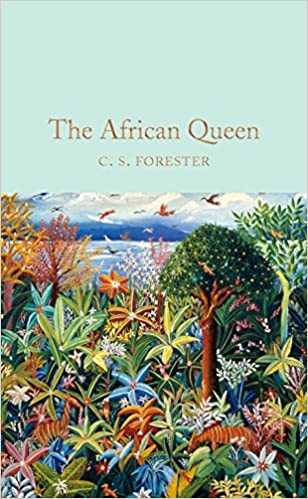
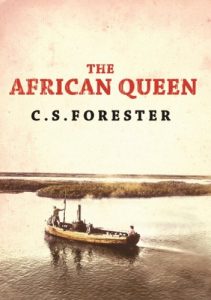
African Queen(2)My father, not a lover of written fiction, preferred films. And one of his favourites was John Huston’s 1951 The African Queen based on CS Forester’s 1935 novel. That meant that I saw it  several times when I was growing up before eventually coming to the novel and discovering what a little masterpiece it is. I doubt that my father ever read it any more than I’ve seen the film since about 1965. But the novel is a firm favourite of mine and it was a treat to take down my well thumbed copy for a revisit.
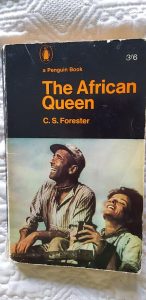
What strikes me now, over 50 years since I first enjoyed it, is what a classic it is in every sense. If you subscribe to the view, as I do, that all fiction is rooted in a handful of basic, timeless stories then The African Queen is at least three of them. In case you don’t know the story it gives us a frumpy missionary’s sister and a cockney mechanic forced by circumstances to escape down a treacherous central African river to outwit the ruling Germans in 1914. Thus it is a quest story as they head for the lake with a crazy plan to strike a blow for Britain. It is also a  seeing off the monster (Germany) narrative and against the odds it is also a very unlikely, passionate, tender love story. No wonder it works so well.

I relish the way Forester, whose writing is economical and sometimes even spare, describes the river with its rapids, shoals, cataracts, bends, rushes, weeds, leeches. The water swirls and changes colour as they haul themselves through the overgrown channels in the delta after the dangers of shooting at high speed through stretches which were regarded by explorers and mapmakers as unnavigable. It’s always sensual, often colourful and never overwritten.

He’s brilliant on the feelings of both characters too – Rose’s dogged determination and Alnutt’s skilful ingenuity create a strong team and the development of the relationship between them is beautifully judged. So are the descriptions of Alnutt keeping the boat going by collecting driftwood to burn in the boiler, repairing propeller and shaft and, eventually improvising a couple of torpedoes.

Of course EM Forster would have had a few things to say about it As he points out in Aspects of the Novel, Homo Fictus doesn’t quite function like Homo Sapiens. Although Alnutt and Rose bathe off the boat privately from each other at first we are left to assume that their bladders and bowels stop working when they leave the Mission. And doesn’t Rose have periods? After weeks of “marriage” to Alnutt she’d probably be pregnant anyway but it’s a minor gripe – and really just a reflection of how many novels were written 86 years ago although I’m not sure I noticed it when I first read it.

It’s quite an accolade for a book, I think, if you can read and like it at 18, come back to it decades later in maturity and still admire it. Rereads can be disappointing – but not this one. I see the film is available on Netflix and I’m wondering whether to revisit that too.African Q old

Next week on Susan’s Bookshelves: A Twist of the Knife by Peter James


Show: Treasure Island

Society: Half Cut Theatre

Venue: The Kentford, Newmarket, Bury Road, Kentford, Newmarket

Credits: Devised adaptation from the novel by Robert Louis Stevenson

Type: Sardines

Author: Susan Elkin

Performence Date: 31/07/2021

Treasure Island

Susan Elkin | 31 Jul 2021 22:47pm

Half Cut theatre certainly knows how to entertain family audiences. And this show, complete with strong story telling, versatile acting, sea shanty-type songs and a wackily witty take on Cha Cha Slide is a fine example of it.

Most people know Robert Louis Stevenson’s story of Jim Hawkins sailing off with a shipload of goodies and baddies in search of treasure and this 80 minute take on it (devised and developed by the company) works because it keeps dropping in little dollops of inappropriately modern language thus never taking itself too seriously. It’s very funny in places. I love the idea of cheese-loving Ben Gunn coming home to run a cheesemonger stall in Leeds Market, for instance.

It’s also splendidly feminist. Verity Kirk plays Jim as a feisty girl with an astonishingly powerful voice. Sophie Wilkinson gives a really sparky account of the complex  Long John Silver full of Scots menace and lithe charisma. And I don’t know whose idea it was to play the parrot as a louche, scarf draped female in yellow tights rather than the usual small puppet but James Camp is great fun in the role.

Francesca Barker, like the rest of the cast, hops adeptly in and out of roles and hats and finds a nice authoritarian stance for the Captainess. George Readshaw is a suitably nasty Blind Pew and hilarious as Ben Gunn who talks to the ducks because for many years they were his only company. And Alex Wilson is good value as the Squire Trelawney who never quite manages to be in charge.

I’m struck, again, by how well this company uses a wide range of accents to underpin the multi-rolling and make it so clear that even the youngest child in the audience will know who is who at all times.

I’m so glad that Half Cut Theatre has a good tour booked for this show and hope the rain continues to hold off for them as it did at Kentford, near Newmarket where I caught it.

This review was first published by Sardines magazine: https://www.sardinesmagazine.co.uk/review/treasure-island-4/

Show: A Midsummer Night’s Dream

Society: Bromley Community Arts Theatre (BCAT)

Venue: Amphitheatre of Church House Gardens. Church Road, Bromley, Kent

Credits: William Shakespeare. Directed by Pauline Armour, Simon Clark, David Evans & Debbie Griffiths

Type: Sardines

Author: Susan Elkin

Performence Date: 22/07/2021

A Midsummer Night’s Dream

Susan Elkin | 23 Jul 2021 10:47am

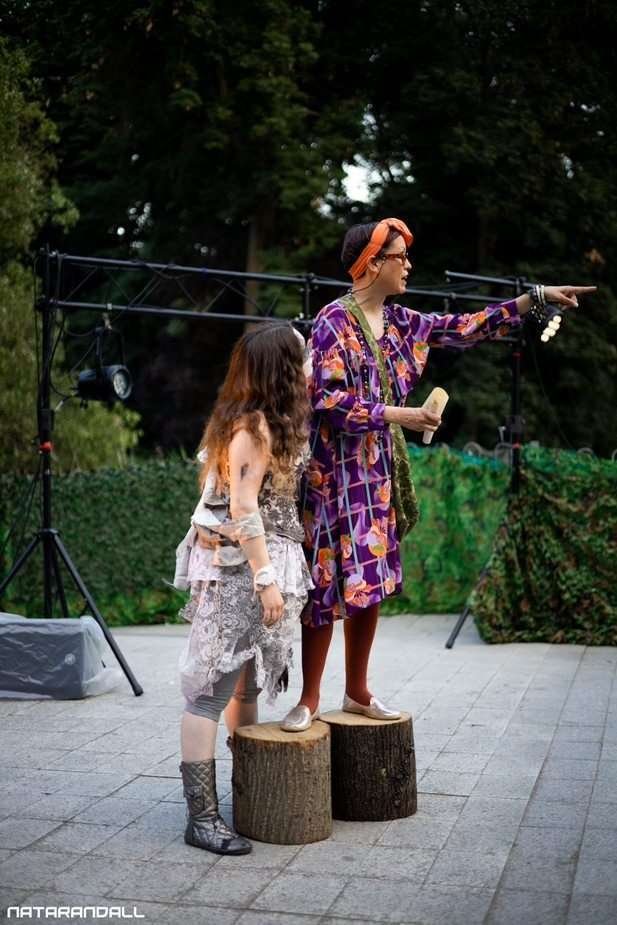
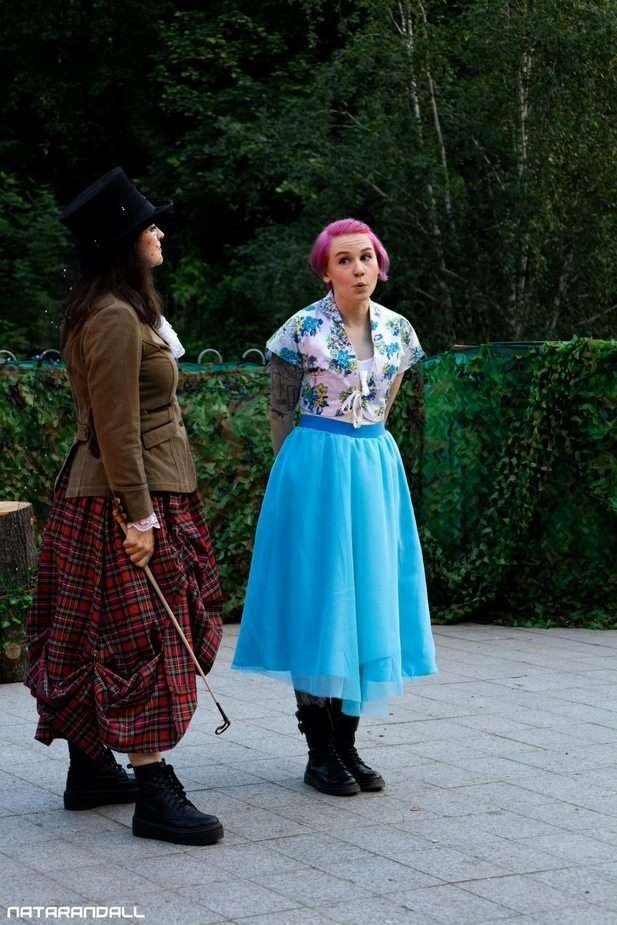
A Midsummer Night’s Dream is so familiar that you might think that there’s not much scope left for originality. You’d be wrong as this interesting and highly competent production shows. Yes, why not have Demetrius and Lysander physically scrapping at the back like schoolboys during Egeus’s tiresome fulminations? Why not set the Rude Mechanicals’ burgomask to a clumpy accelerating version of the clog dance from La Fille Mal Garde with the three couples joining in? Why not put the Mechanicals in identifier placards for Pyramus and Thisbe so that they further subvert their own play? And those are just examples.  Directorial good ideas show up in nearly every scene – possibly because it is, unusually, directed by a quartet rather than by an individual.

The large cast – drawn via open auditions from amateur companies across the London Borough of Bromley – have not worked together before because Bromley Community Arts Theatre is a new venture. But, my goodness, they work smoothly as a team. The lovers’ quarrel in the wood is so slick and funny that it got a spontaneous round of applause in the performance I saw. Sarah Kidney simpers and sneers as Hermia. Alice Foster gets more and more upset and angry. And Robert O’Neill and Daniel Pabla as Lysander and Demetruis respectively have worked up a finely nuanced double act.

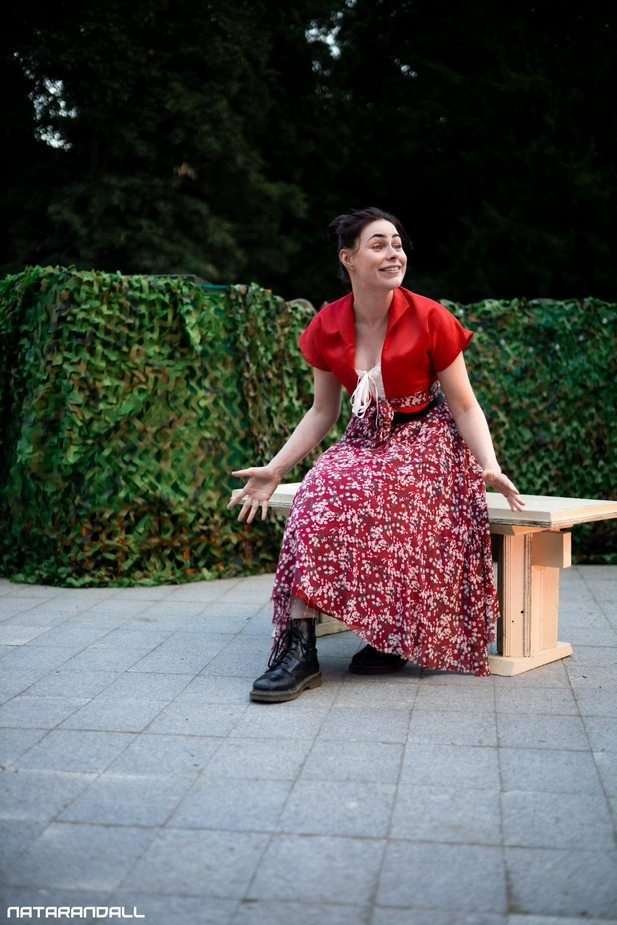
I really liked David Evans as Oberon. He has a very musical delivery managing both high and low “notes” with total clarity and audibility. He also conveys all the necessary charismatic gravitas and sinister other worldliness. Like all the cackling and hissing fairies, he wears floaty grey and black robes with lots of black and white makeup.  The rest of the cast are more or less in a fairly spiky form of modern dress with Hippolyta (Alicia Clarke, who plays her rather engagingly as quasi dominatrix with feminist sympathies) sporting a magnificent scarlet dress and gloves for her wedding.  Costumes are subtly colour coded too which is a neat touch. The nobles are in red and turquoise and the mechanicals in brown.

Most outstanding of all is Chris de Pury as Bottom. He commands the stage and knows exactly how to squeeze every possible laugh out of every word. His soliloquy when he wakes from the dream is one of the best I’ve ever seen. It is notable that he, like almost everyone else in this cast, manages to make the text sound freshly minted and very clear. The audience were laughing not only at stage business and situations but at the text itself and that is an achievement for any company.

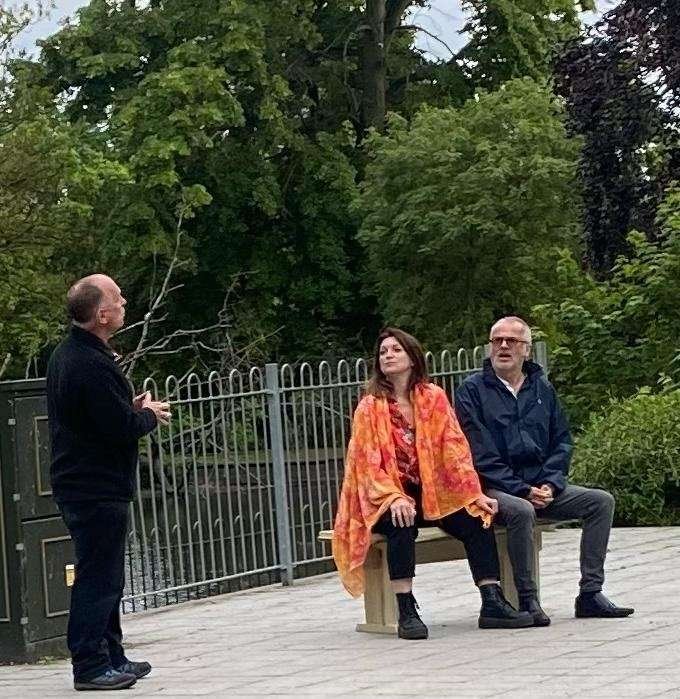
The show sits beautifully in the amphitheatre in the park which, I gather, has not been used for a proper play for 20 years. The enormous trees and the lake provide a perfect setting and I’m pleased to learn that there are now plans to use the space again.

Bromley CAT has managed to stage this enjoyable production under extraordinarily difficult circumstances including Covid, restricted rehearsals and having to change venues three weeks before the opening. Warmest congratulations, therefore, to everyone involved and I look forward to seeing more work from this company very soon.

First published by Sardines Magazine: https://www.sardinesmagazine.co.uk/review/a-midsummer-nights-dream-9/