Press ESC or click the X to close this window

The Wolves (Susan Elkin reviews)

The Wolves – Tower Theatre, London

Reviewer: Susan Elkin

Writer: Sarah DeLappe

Director: Ragan Keefer

Nine high school students constitute a women’s soccer team, The Wolves, in an unnamed North American city. They meet to warm up and play each Saturday and that provides the structure for the unfolding scenes in Sarah DeLappe’s appealing and quite original play. They sit chatting, often over each other, in a circle as they stretch, in a sort of visual chorus. Each girl has a number on her back. Her given name, if we ever learn it, is subsidiary. They are first and foremost a team who huddle together and chant “We are the Wolves” as a bonding exercise before each match.

The play showcases young female talent and there are some strong actors in this cast whose delivery is naturalistically convincing. There is also some very attentive active listening as they discuss the Khmer Rouge genocide in Cambodia, along with cancer, immigration and abortion among other things including, of course, their coach and the details of the forthcoming tour.

Inevitably there’s someone in the room with experience of each of every contentious topic so toes get trodden on. And this deepens as they pair, still talking, for dribbling practice, each two passing across the stage, configured in the round for this show, which is unusual for Tower Theatre.

Amongst a generally good cast, Thea Mayeux is outstanding as #13. She is the joker/leader, making silly faces and putting on voices and generally being the brittle, disruptive, often cruel, teenager no teacher wants in a class. But of course, she’s also vulnerable, which is why she shows off constantly, and Mayeux nails that perfectly.

Eventually – the play runs 90 minutes without interval – disaster strikes and one of the team dies so the action becomes more subdued as they talk about her and her funeral. The mood finally leaves changing room banter behind when Amanda Charalambous, as the dead girl’s mother, arrives to address them while they each sit in their usual circle but still, silent and gazing uncomfortably at the floor. Competent as Charalambous is, this overlong scene is the least successful thing in an otherwise well-paced piece.

Runs until 1 February 2025

The Reviews Hub Score  3.5

Female football as vehicle for issues

Review first published by The Reviews Hub

Maidstone Symphony Orchestra

Brian Wright

Ben Goldscheider

Mote Hall, Maidstone

This imaginatively programmed concert gave us three mid-twentieth century works all premiered within four years of each other, under very different circumstances. There was, therefore plenty of range to appreciate.

Leonard Bernstein’s Candide overture is an extravagantly exciting piece and a challenging concert opener because it has to go fast and furious to be as exhilarating as it’s meant to be. Wright steered the orchestra through  those  helter-skelter, off-beat rhythms and lush melodies with panache and all praise to piccolo player Barbara Love both here and in the two following works. She was kept pretty busy throughout the evening.

We’re very used to the horn concerti of Mozart and Strauss – but what about  Reinhold Glière who was a contemporary of Rachmaninov and whose concerto is pleasingly tuneful? It should get far more outings. Soloist Ben Goldscheider, whose poised control is remarkable, found soulful legato in the long phrases of the first movement and some unusual sounds across three and a half octaves in the cadenza. The Andante is a bit syrupy and could be mistaken for film music, but Wright ran with its excesses and the blending of horn (rich and creamy sound, here) and strings was nicely balanced. The third movement is shot through with Russian folk melodies including a tune I know as “London Bridge is Falling Down”. Goldscheider played every note with crisp clarity in what was a very enjoyable performance of a piece new, I presume, to most of the audience.

And so to the brooding majesty of Shostokovich’s classically structured, and vast, tenth symphony written soon after (and maybe to commemorate) the death of Stalin. It’s not a piece many community orchestras would have the courage to tackle but MSO carried it off from the escalating, lugubrious angst of the opening with the plaintive brass all the way to the rousing final bars with their astonishing, bravura timp work. And at a practical level it must have been satisfying for the orchestra to rehearse and perform because there’s so much for everyone to do.


High spots included the unsettling violin pizzicato  with flute and the growling contrabassoon in the first movement and the strident, aggressive energy of the second movement which – the composer was coy about it – may be a representation of Stalin. There was some pretty arresting playing in the Allegretto with that disturbing recurrent motif and full marks to Andrew Laing for dynamic leadership, especially in this movement.  Then the peaceful resolution and triumphant brightness in the finale were communicated fully, particularly by the brass and percussion sections.

I was pleased to see a slightly fuller hall than sometimes for what turned out to be and interesting and enterprising concert.


Bruckner Symphony no 7

RAM Academy Symphony Orchestra

Ryan Wrigglesworth

Dukes Hall, Royal Academy of Music


It was a real pleasure to be back at Royal Academy of Music to hear accomplished, emergent players out in force to showcase the results of their work with Ryan Wrigglesworth this week.

And Bruckner 7 was an excellent choice. Not only has it been the best known of the composer’s works since the rapturous reception it received at its Leipzig premiere in 1884, but it’s written on a grandiose scale so there’s plenty for everyone to do.

It’s a symphony full of memorable melodies and colour – hence its popularity – and after graceful negotiation of that tricky tremolo start , the Em major cello tune sang out joyously. Wrigglesworth balanced the sound nicely in the rather glorious Duke’s Hall acoustic, throughout out the challengingly long opening Allegro moderato movement with an exceptionally dramatic take on the big rallentando towards the end.

There was some sumptuously beautiful playing in the rising, soaring C# minor melody in the Andante (good tuba work) which is probably the finest movement in the symphony although it’s a hard choice. The climatic section with string arpeggios, trombones – and the famous cymbal clash – was pretty fine too.

The principal trumpet really excelled, as he or she must, in the scherzo and I admired the way Wrigglesworth controlled the manic string work and contrasted it with the gentler trio.

And finally back to E major for the finale which in this symphony doesn’t really resolve anything. This performance gave us some excellent work from the brass section in the grand marcato statements and sensitive attention to dynamic contrasts here as in the rest of the work.

Whether or not you share Bruckner’s staunch, reverential Catholicism (and I don’t) this is a profoundly inspirational work. The players were audibly inspired both by the work and by Wriggleworth. It’s also a piece which, given its length, requires a lot of stamina but of course these young players rose to the challenge with aplomb.

The Gift

By Dave Florez

Directed by Adam Meggido

Park Theatre, Finsbury Park

Star rating: 3

A nicely paced three hander comedy, The Gift opens with three people staring horrified into a cake box. It has arrived through the post and contains a human turd.

The named recipient Colin (Nicholas Burns), who evidently has anxiety problems, is being supported by his sister Lisa (Laura Haddock) and his university friend Brian (Alex Price), who is now also his brother-in-law. As situation comedy goes, it’s pretty funny and Dave Florez’s dialogue zings along.  All three actors are compelling and there’s a lot of fine acting in this production along with some effective use of well timed, “loud” silences when characters are horrified, incredulous or dumb-struck.

For the 110 minutes that the action of this play runs (it’s billed at 2 hrs and 10 mins including interval) these three characters discuss, argue,  and attempt to think rationally about, who might have sent the “gift” and why. Colin, who has no sense of humour and is probably on the autistic spectrum, prepares a massive spreadsheet. There’s a falling out with the patisserie whose box was used – and a reported police incident as Colin gets ever more manic. Brian, meanwhile, tries to be rational but is at heart a joker. Lisa patiently and articulately tries to arbitrate between them but clearly finds them both hard work. And so it marches on through various twists and turns.

Although this is an entertaining piece, guaranteed to make you laugh, the basic idea is too thin for a play of this length. It would have worked better as a brisk 60 minute one act job. The final minutes are a bit tame too, bringing us an unexpected upbeat development in the relationship between Lisa and Brian which feels pretty contrived.

Runs until 01 March 2025

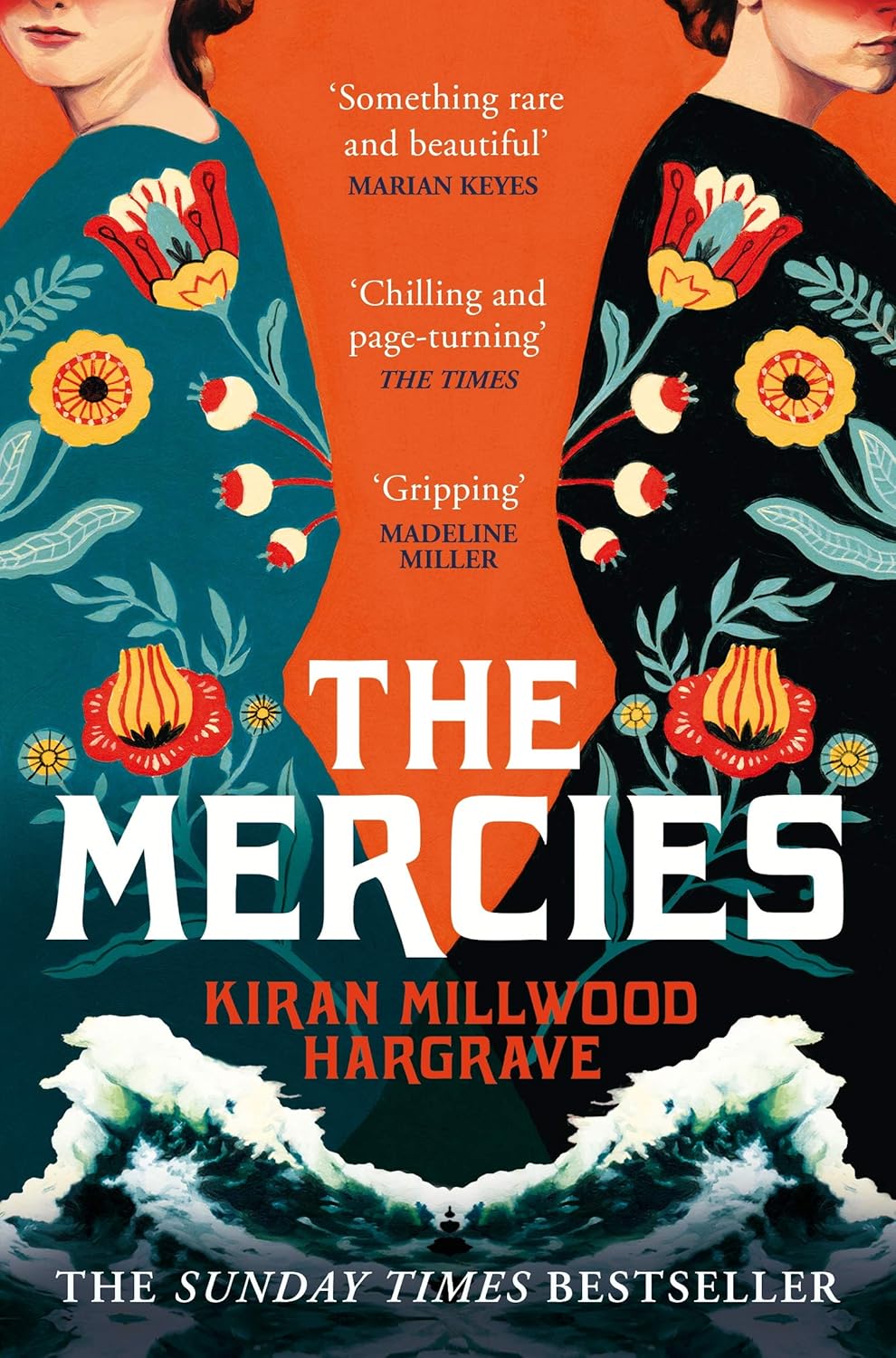
The friend who recommended this book to me didn’t explain what it was about. She simply told me so fervently how much she’d enjoyed it that I got my phone out there and then (we were in a restaurant) and ordered it. And I’m very glad I did.

I think it’s probably the first novel I’ve read which is set in seventeenth century Norway, the remote part, north of the Arctic Circle, and featuring a female gay love story.  Full marks to Millwood Hargrave for originality – and for writing some of the most arresting prose I’ve read for some time in a modern novel.

First the real events which inspired The Mercies (2020): In 1617 a sudden catastrophic storm drowned forty fishermen off the island of Vardo. Soon King Christian, influenced by James VI of Scotland and his famous treatise against witchcraft Daemonologie, was sending in witch hunters to wipe out the extant paganism in the distant north of his country. And it wasn’t long before hapless women were being blamed and ruthlessly murdered for conjuring that famous storm. Of course, I’ve read both factual and fictional accounts of witch hunts in East Anglia and Massachusetts but hadn’t before connected it with Norway although in fact it was a blight which spread right across Europe.

Millwood Hargraves imagines the horror of a whole village of women left without their men in a bleak, underpopulated place which is dark for half the year. Maren struggles at home with her difficult mother and bereaved, rather distant sister-in-law. The latter, is Sami which means she is regarded as “foreign”. The women go out fishing which is strictly against social mores. It’s that that or starve.

Then a commissioner, Absolom Cornet arrives with his new wife Ursa, the other character from whose point of view the story is presented. Ursa has come from a comfortable home in Bergen and is both horrified and flummoxed by the primitive hut they’re assigned. So very tentatively she asks Maren to help her and, gradually a warm friendship evolves. The reader can see and feel where this is going long before the two women involved do. In their different ways each is as naïve and innocent as the other.

Meanwhile Absolom and his cronies are doing (enjoying?) what they regard as their ruthless duty to root out witchcraft in the community, using lies and torture to get what they want. First there’s Maren’s feisty friend Kirsten along with the only woman in the village who has a comfortable – and crucuially –  covetable home.  Political corruption is, of course, alive and well. The graphic accounts of what happens to these two women highlights the cruelty and despair. And we know that Maren’s sister-in-law with her runes and charms is on the hit list and that Maren herself is in danger. It is terrifyingly convincing.

Millwood Hargrave is very good at the geographical detail. When Maren abseils down a cliff to collect guillemot eggs, you can feel the granite beneath her hands and feet, not to mention the swirling of the icy sea many metres below.  We journey northwards with Ursa on a ship too and just reading of the privations and the motion  made me feel seasick. And the practical, physical detail is strong. How on earth do you deal with forty washed up bodies when you’re just a group of undernourished women and can’t get a pickaxe into the frozen ground?  Answer: You have to store them until spring in a hut which acts as a quasi freezer. For months these women feel obliged visit the bodies of their dead loved ones. It’s heart-wrenching stuff but it’s also uplifitingly affirmative. Somehow most of these women will survive.

Inspired by this. I shall now order and read Millwood Hargrave’s other titles of which there are several. That’s the great thing about reading isn’t it? It’s like a treasure hunt. One good thing always leads to another.

Next week on Susan’s Bookshelves: The Hollow Crown, Shakespeare on how leaders rise, rule and fall by Eliot A Cohen

A Midsummer Night’s Dream

By William Shakespeare

The Whole Pack Theatre Company

Directed by Jessamy James

The Cockpit


Star rating: 4.5


I wish very much I’d seen this thoughtful, charming touring show earlier in its run rather than at the point when it finally came to rest in London at Cockpit Theatre. Some good things, however, really are worth waiting for.

Reimagined as a winter show for Christmas (preceded by Winter from Vivaldi’s Four Seasons to get you in the mood) it opens not in the usual place, but in a snowy wood where Oberon and Titania are quarrelling. And, incidentally, I’d never before spotted the all-too-topical climate change references in that scene.

Singing is a key element in this all-female six-hander. It is folksy, haunting, includes old carol “The Holly and the Ivy” and is full of colourful, skilfully articulated harmonies. The MD is Meghan Louise Taylor who really has done a splendid job. A trained, and evidently accomplished, opera singer, she also gives us one of the funniest Bottoms and the most imperious takes on Theseus, I’ve seen in years. She uses her physicality to terrific theatrical effect whether she’s idyllic because the fairies are scratching her back, upstaging her fellow rude mechanicals or pronouncing a potential death penalty on Hermia.

Amongst a strong cast, Jessamy James, for whom this is also her directing debut, is feisty as Titania, furious as Helena and, as Snug the Joiner, provides the voice of aggrieved common sense to offset Bottom’s high jinks in the Pyramus and Thisbe scenes. And Charlotte Frost delights as sweet, tricked Hermia and is splendid as longsuffering Peter Quince – the fresh, take on his prologue is a lovely bit of theatre. The multi-roling is neatly managed with characters creeping off stage to reappear very soon afterwards in different guises. Most of Amanda Beauchamp’s modern dress costumes, attractive as they are, are pretty simple to get in and out of at speed.

And James has come up with some ingenious directorial ideas. For example, there is, perforce, no noble audience to watch Pyramus and Thisbe so the theatre audience becomes a substitute – with a bit of participative banter led by Frost. Then the device which brings the action back to the plays final gorgeous speeches is entertainingly seamless. The quarrels and fights between the lovers in the woods work well too – with actors disappearing off stage but still shouting at each other.

I have probably seen A Midsummer Night’s Dream fifty times, I used to teach it to secondary school students and know the text almost by heart. The joy of this production is that it respects the text, most of which is still there. It’s astonishing how few big cuts are required to make it fly with only six actors. I also admired the way James and her cast brought out all the humour in the rhyming couplet sections – because some productions make little or nothing of this.  And the occasional tinkering with the script was masterly. “Athenian knitwear” instead of “garments”,  anyone?

The production sits  on a very simple set in the  Cockpit’s square space  which has – imaginatively used –  entrance points on all four corners. It’s colourful, full of humour and very beautiful: one of those rare shows it which it was quite difficult not to smile with pleasure throughout.

The Whole Pack is a newly formed theatre company whose aim is to explore and create versions of classic drama for all-female casts. This joyful, wintry Dream was its first show and I’m looking forward very much to seeing what they do next.


Lovers’ Vows

Elizabeth Inchbald

Historia Theatre Company at Jack Studio

Directed by Kenneth Michaels

Star rating 3

I pounced on this 1798 play with glee because it features prominently in Jane Austen’s Mansfield Park (1814) a novel I know very well. In the novel it serves as a symbol of decadence as the bored young people decide to stage a play while the master of the house is away. It must have been very popular in its day because Austen clearly expects her readers to be familiar with it as her characters argue about casting and begin to rehearse.

In fact the “shock horror” factor created by Austen is even more ironic than I had ever previously realised because it’s a very harmless little play – written at a time when people were more frank and less much less prudish than they were fifty years later once the Victorian age was firmly underway.

We’re in Germany and Europe is at war. Agatha (Kate Glover, who founded this company in 1997 to stage historically interesting plays) is destitute because she once bore an illegitimate child to a local nobleman who abandoned her. Then, after a five year absence her soldier son, Frederick (Matthew Thomason) turns up and they are reunited. He does what he can to make her comfortable with the assistance of a cottager (Richard Ward) and his wife (Hilary Field). Inevitably, then the, conveniently widowed, Baron (Harry Saks) moves back to his nearby castle with his daughter Amelia (Emma Riches). He plans to marry her to Count Cassel (John Craggs) who is absurd and hilariously undesirable in the tradition of a Shakesperean comic but she is in love with the local cleric (Edmund Digby Jones). The count and his household are served by a butler (Gareth Pilkington) who writes poetry. Of course, after a few hitches, we get a Mozartian “suo padre” moment because Frederick is the product of that long ago liaison between the Baron and Agatha who are reunited to give us a happy ending. It would make a good comic opera. Has anyone, I wonder, ever done it?

This production feels wooden and pedestrian at the beginning – although I saw it very early in the run so there may have been nervousness which showed. There is too much standing still and speaking lines. It gets better as it settles though, especially in the second half. Amongst its quite large (for fringe theatre) cast there are some strong performances. Digby Jones stands out as Mr Anhalt, passionately in love but suppressing it and trying to help others as a decent clergyman would. And Emma Riches gets exactly the right tone and body language for an early eighteenth century young woman who knows her own mind.

I’m very glad to have seen Lovers’ Vows, at last. Next time I reread Mansfield Park I shall see it in a whole new light.

First published by London Pub Theatres Magazine

Although Noel Streatfeild’s best known (and first) novel was published back in 1936, I didn’t read it in childhood. I was not a “ballet child”. My mother loathed what she called “little girls showing off” so there was never any question of it. I was in my twenties before I saw my first ballet although I had long been familiar with much of the music.

I discovered Ballet Shoes in the 1970s when I began teaching in girls’ schools and it made a good Year 7 class reader at a time when we had no National Curriculum shoving us towards “relevant” texts featuring death, multiculturalism, sexuality and the like. But I hadn’t read it, or even thought about it, for a long time. Then, earlier this month I saw and enjoyed Kendall Feaver‘s imaginative adaptation for the National Theatre which sent me scuttling back to the novel to remind myself of what Streatfeild actually wrote.

My first observation is that, although to some it might seem datedly “twee” and white, this is actually a pretty gritty novel. Here we have three adopted girls growing up in an unconventional family headed by a young woman and an older one. The youngest child, Posy, has actually been abandoned/relinquished at birth which is a difficult issue for any child at any time. Two of the lodgers are a female gay couple. This is clear but not overt in the novel. Nearly 90 years later Feaver can, and does, run with it openly in her adaptation.

Then there are the feminist issues. Petrova is not interested in the performing arts other than as a means of shoring up ailing family finances. She wants to be an engineer and we recognise that she probably will be. Pauline, a talented actor, is determined on a career of her own, as is the sometimes tiresomely single-minded Posy who dances: exactly the sort of child my mother would have detested and put down promptly. On the other hand, she too is focused on her own development and success. Yes, they are dependent on a man, sort of. The missing Great Uncle Matthew (GUM) is a palaeontologist who has been gone a very long time and no one knows whether he’s dead or alive. The money he left has run out. Each of them, therefore, has to pull her weight and it’s empowering and uplifiting for the reader. Considering the date of this novel, Ballet Shoes is remarkably progressive.

It’s also beautifully written and a good read. Every character is colourfully realistic. Moreover, I enjoyed the theatre references when I first encountered it and did so again now. There’s a production of A Midsummer Night’s Dream in which Petrova, who’s not a natural, really struggles with Peaseblossom’s “I too” and a Richard III in which Pauline excels, as she does in a film where she plays Charles II’s sister which turns out to be her “break”. This was actually Noel Streatfeild’s own world. She was a RADA trained actor herself which is why rehearsal scenes and the like are so convincingly presented.

Ballet Shoes has never been out of print and is now, justifiably, regarded as a classic. Any young person reading it today could be the fifth or sixth generation in his/her family to enjoy the ups and downs of Pauline, Petrova and Posy as they grow towards their respective destinies. And there’s something special about a parent or grandparent handing on a book they remember with affection. My mother led me to a number of books which became lifelong favourites but, of course, none was about ballet. We’re all different, thank goodness.

Next week on Susan’s Bookshelves: The Mercies by Kiran Millwood Hargrave