Press ESC or click the X to close this window

Festen (Susan Elkin reviews)

Writers: Thomas Vinterberg, Mogens Rukov and Bo Hr. Hansen adapted for the English stage by David Eldridge

Director: Allan Stronach

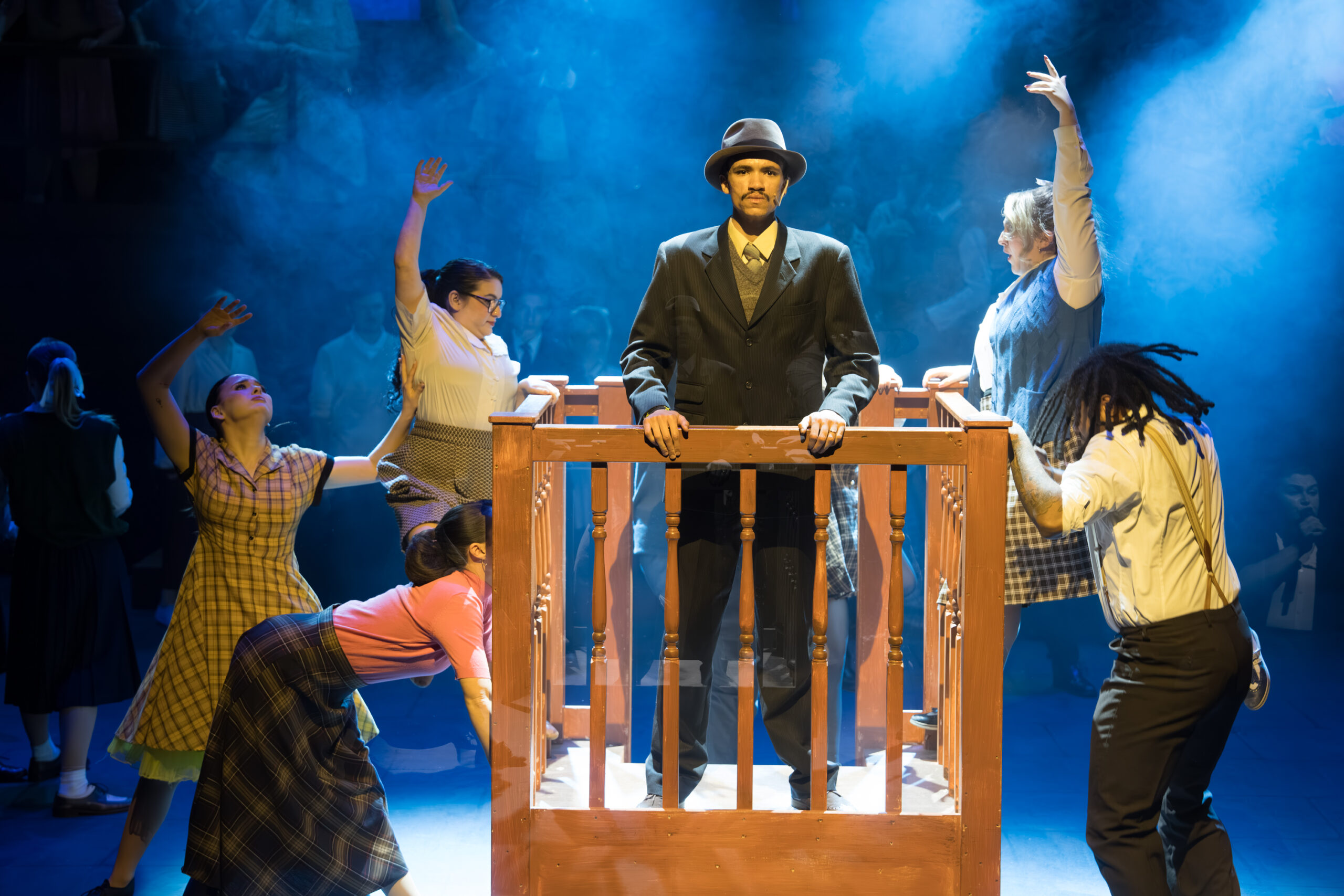
Festen, ironically subtitled and translated “the celebration”, depicts a wealthy Danish family gathering for the 60th birthday of its head, Helge. Nothing is as it seems, and there’s certainly no reason to celebrate anything.  We’re in the world of Strindberg, Ibsen and Chekhov with group dynamics, subtext and tensions bubbling. It feels like a play from a very different era, although, surprisingly, the film which David Eldridge has adapted dates from 1998.

Online movie streaming services

Joshua Picton is outstanding as Christian, the eldest of Helge’s four children. Initially urbane – although at first there’s fierce tension with his irascible younger brother Michael (Alexander Dalton) – he drops a revelatory bombshell in his birthday dinner speech, and the effect is devastating. His twin sister, Linda, has died by suicide for reasons which now become apparent.

And the later crazed, half-drunk scenes in which Picton’s character mistakes his young niece (Eloise McCreedy, who alternates with Millie Howard at other performances) for his much missed sister are as moving as they are disturbing. Meanwhile, he’s been having sex with Pia (Medea Manaz), one of his father’s staff, for some time, although she’s keener than he is. Those scenes are subtly strong, too.

Martin Shaw is pleasing as Helge as much as we come to loathe him, and there’s an enjoyable performance from David Lindley-Pilley, the deliciously camp servant who does his job efficiently while missing nothing and refusing to be put upon. And, as at every family gathering, there are the eccentric outliers: the dim, drunken uncle (Daniel Watson – nicely observed) and the grandfather with dementia (Andrew Robinson – perfect).

As always, though, the show rests on the skill of the director, and Allan Stonach is very good at deafening silence when every character is so astonished, overwhelmed or distressed that no one knows what to say – so they don’t. During, for example, the main course at dinner, nobody speaks for a while, and all you can hear is cutlery scraping on plates as the tension builds. The scenes in which the well-oiled dinner guests sing and cavort across the set in a sort of manic conga-style dance, pretending nothing is wrong, are effective too.

Angelika Michitsch’s triangular set supports the action neatly. She has a long screen (the dining room wall) across the right angle of Tower’s triangular playing space so that characters can emerge from either side or make a circuit as you might in a large country house through several rooms. Two wall cupboards are flipped over to become beds, and there’s an ingenious scene in which three couples are paralleled in three different bedrooms while all are in the same physical space.

Festen is a brave choice for a community theatre, but, as it almost always does,  Tower Theatre has risen ably to the challenge

Runs until 29 November 2025

The Reviews Hub Star Rating

3.5 stars

Danish, dark and disturbing   

I recently saw and reviewed a stage adaptation of Frankenstein which re-invented Victor Frankenstein as Victoria and seemed to omit rather a lot of detail. I wasn’t sure though because, although I’ve seen at least six stage versions over the years, it was a long time since I’d read the book. Time then, to go back and remind myself what Mary Shelley actually wrote.

First published in 1818, the novel was revised by the author in 1831 and that’s the version most of us are familiar with today. It is, though, extraordinary to think that this one-off piece of sci-fi first appeared in the same decade as all six of Jane Austen’s Regency satires which are as full of bright light as Frankenstein is of brooding darkness. It probably isn’t completely facile to see this partly as a reflection of the two authors’ different circumstances. Austen lived in modest comfort all her life. Shelley, who eloped when she was 16, traipsed uncomfortably across Europe with Percy Bysshe Shelley, in exile and debt, giving birth to child after child, most of whom died. Aged 19, she wrote her novel in Switzerland in response to a challenge from Byron who was a neighbour. One adaptation I saw used that famous rainy day conversation as a framing device.

Mary Shelley’s own framing device gives us Captain Walton on a ship trying to reach the North Pole, surrounded by ice, mystery, danger and strange light. Then his men spot a peculiar creature heading away on a sledge. It is very large, otherworldly and frightening. Have they imagined it? Shortly afterwards they rescue Victor Frankenstein, imperilled on the ice. His huskies are exhausted and so is he. Eventually Frankenstein, who had been chasing the creature on the sledge, spends a week telling his story to Walton who confides it to his sister in letters. It’s a Russian Doll narrative – like Wuthering Heights, The Woman in White or many more recent novels by writers such as Victoria Hislop.

Victor Frankenstein is fascinated by what we now call science from childhood and, remember, this novel was written at a time of new revolutionary scientific thinking. Geologists were beginning to question conventional religious dogma about creation. Electro-magnetism was gradually being better understood. There were increasingly powerful microscopes and telescopes. And prodigiously bright Shelley was very well read. Eventually her protagonist builds a body and gives it “animation”. Of course it’s irresponsible. Once the creation (variously referred to in the novel as monster, fiend or daemon) is given life it is beyond Frankenstein’s control. He tells no one what he has done – until he confides in Walton on the ship in the Arctic.

Conveniently the Creation escapes and learns language – implausibly sophisticated language –  by spying on a newly impoverished family living in an Alpine hut. When he finally confronts his creator – dramatically on a glacier – and they repair to a hut to talk , he states his terms. The “monster” wants a female companion because he has feelings and needs. If these are not met he will revert to savagery and he has already shown what he’s capable of. Well, I’ll spare you the spoilers just in case, unlikely as it is, you don’t already know this story which has been made into more films than you can shake a stick at, including Guillermo del Toro’s new 2025 version. It’s a creation (in every sense) which just goes on giving.

What struck me though, on rereading now, is that Shelley was not writing screenplay inspiration for horror movies a century and three quarters after her 1851 death. Yes, it’s a “gothic” novel and the Creation terrifies everyone who sees it. The best stage version I ever saw, by the way, presented him as a huge puppet made of thick ropes for muscles. However, Frankenstein  also poses some pretty profound, ever topical questions.

Are we responsible for the actions of our own creations – our children, for example? If so, should believers in a conventional, omnipotent God blame him for all the evil in the world? What exactly do we mean by “humanity” and “humanness”? Is it morally right to destroy what you see as evil? Is company essential to human life? It’s even worth asking if Shelley’s Creation is actually real? Could he be Victor Frankenstein’s alter ego? It’s an interpretation which would make this novel an interesting precursor to Robert Louis Sevenson’s The Strange Case of Dr Jekyll and Mr Hyde (1886).

No wonder Frankenstein has been studied in universities all over the world, set for exams at every level and widely discussed in book clubs.

Next week on Susan’s Bookshelves: The Diver and the Lover by Jeremy Vine

REVIEW: WRAP PARTY by Harry Petty at Jack Studio Theatre 11 – 15 November 2025

Susan Elkin • 13 November 2025

‘Beautifully observed hilarity’ ★★★★

This two hander was inspired by the creators running a cramped catering caravan on a busy film set and it’s terrific fun. Half the stage (right) comprises a realistic catering kitchen in a capsule so that the actors can run in and out of it, take orders and use the “outside” space which is the rest of the stage. Designers Alfie Frost and Tash Tudor have done a good job with this.


And there’s a lot of beautifully observed hilarity in Harry Petty’s play. This film set is full of outlandish characters with huge egos and Ollie Hart and Harry Warren, both fine performers, play them all with a wide range of voices, the odd hat and a couple of pairs of glasses. At one point Hart does a three way conversation all by himself and it’s very funny.

Yes, we can all sympathise with their having to deal with “Clipboard Claire” who officiously guards health and safety and eventually closes their caravan because someone has put a dog poo bag in the bin. Then there is the customer so entitled she jumps the queue and asks for six ludicrously complicated drinks – a familiar stereotype. Even the elderly director who has an accident in the loo so Olly lends him a pair of trousers has a ring of truth to it. It rattles on with as much realism as romp. And the asides to audience are nicely judged.

And yet, like all good comedies, there are some serious issues underneath to give the play a bit of depth. Harry’s relationship has just broken down and he’s hurting. He and Ollie exasperate each other but the play celebrates the strength of their friendship. It’s Harry’s catering business but he really wants Ollie to work with him. And we feel the dichotomy he faces at the end – until an unexpected piece of information ends the play and we all laugh again.

This entertaining, pleasingly original show runs just over an hour and is well worth catching.

WRAP PARTY Written and directed by Harry Petty

at Jack Studio Theatre 11 – 15 November 2025

BOX OFFICE https://brockleyjack.co.uk/jackstudio-entry/wrap-party/

Cast: Ollie Hart and Harry Warren

Written and directed by Harry Petty

Contributors: Ollie Hart & Harry Warren

Set Designers: Alfie Frost & Tash Tudor

Lighting Designer: Conor Costelloe

Sound Designer: Lauren Ayton

Composer: Josh Tidd

Graphic & Digital Media Designer: Luke O’Reilly

Stills and Videography: Toby Everett & Alicia Pocock

Producers: Lucy Ellis-Keeler & Tara Jennett

Presented by You Guys Productions Ltd.

Photography: Toby Everett

Review first published by London Pub Theatres Magazine

Lightning Beneath the Waves

David Hovatter and Company

Studio, Questors Theatre

 Star rating 2.5

It’s a strong story told with muscularity. Two determined men – an engineer and a financier –  set out, against near impossible odds, to lay a cable under the Atlantic Ocean to link America with Europe. Eventually they succeed, with a bit of help from Isambard Kingdom Brunel’s Great Eastern steamship thereby, in 1866, dramatically furthering the development of modern communications.

It’s a good example of non-professional actors working together to create something vibrant and interesting. Using physical theatre, mime, dance drama and rhythmic song the all-female ensemble of eight becomes navvies, shareholders, the ocean and a lot more. There are some talented performers in this company. And it sits quite well in the traverse space of Questor Theatre’s studio. The two acts are disjointed, however. For a long time after the interval it feels as if we have arrived in a different play.

The most impressive actor is Craig Nightingale, who like Marcus Boel (fine singer) also joins the ensemble. His Cyrus Field has gravitas, enthusiasm and is pretty convincing especially in his scenes with Boel’s passionate Frederick Gisbourne. In the second act we move to Britain and meet Brunel (Jerome Joseph Kennedy) himself, complete with trademark hat which becomes a symbol in this piece. Kennedy has commanding stage presence and the clearest diction in the cast but why on earth does he speak in rhyme? And it was a mistake to ask him to sing.

This show is effectively a folk musical. Robyn Backhouse, using guitar and voice, leads a pleasing four-piece band at one end of the space. She is also credited as “sound designer” which presumably subsumes the MD role. The songs are repetitively and tunefully haunting but “folksiness” should not be used as an excuse for poor choral singing which often lacks power and is frequently out of tune.

Hovatt admits in his programme note that it’s a challenge to make technical information feel dramatic and this is a brave effort. There is is, though, still too much wordy exposition mostly delivered in short bursts by ensemble members.

Moreover, the transverse space makes for audibility problems especially as several cast members are second language English speakers with strong accents. It was fortunate that I saw a captioned performance because without that I would have missed much of the text.

And finally, this show is billed at 90 minutes including interval. In fact it runs – with completely unnecessary post-curtain call extra song – 125 minutes including interval. I am a very busy reviewer and I routinely travel all over London and beyond: QED. However, it takes me two hours to get to Ealing and usually longer to get home because it’s harder to plan the connections. Inaccurate running times (33% longer than stated in this case) are not helpful. Courtesy issue?

Writer and Director: Marc Blake  

We’re on a private island owned by a billionaire who collects world-famous art. Rising Black artist Joan has a residency set up by the collector’s agent, David. Then a museum curator arrives with an important painting to sell. The play builds up – rather as Act 2 of The Mikado does –  to the arrival of the Great Man and his American wife Vanessa. Then the painting disappears during a thunderstorm, and that’s the central mystery of what is essentially a whodunit without a murder.

For a long time, it feels like a pretty predictable comedy of manners – Joan’s forthright gor-blimey ones contrasting with everyone else’s. She gets the funniest lines, and Oyinka Yusuff delivers them with aplomb. There are, however, some unexpected plot twists in the final third. These are totally implausible in view of what has gone before, but they trigger audience gasps and chuckles.

Alan Drake is strong as the exasperated, long-suffering dealer (who turns out to be something completely different) and Jon Horrocks is convincing as the authoritarian collector accustomed to having his own way in everything – until, inevitably, the tide turns against him. Jeremy Vinogradov is pleasing as the humourless museum curator. Naomi Bowman, however, isn’t persuasive as Vanessa with her high-pitched American whine – not quite right for her Virginian provenance and is often inaudible.

The most interesting aspect of Private View is the questions it asks about the value of art. Its real value surely has nothing to do with money, as Yusuff’s character tries to assert. It is not an argument which is fully developed, and that’s a missed opportunity.

Mark Blake’s debut play has an oddly old-fashioned feel despite the mobile phones and occasional “fuck”. It runs 90 minutes and doesn’t need its interval. It should be a straight-through play.

Moreover, the scene changes are clumsy, and that effect is worsened by an unfortunate audience decision on the opening night to applaud, 1950s-style, every time characters leave the stage and there’s hesitant presumption of a scene change.

And it’s time Greenwich Theatre did something about the sight lines (a polite misnomer) from the back row of its studio theatre. The stage is virtually invisible. Many school halls are better.

Runs until 15 November 2025

The Reviews Hub Star Rating: 2

40%

Mildly amusing, clunky whodunit

I had never read a Jilly Cooper novel nor seen any sort of dramatisation. It simply didn’t sound my sort of thing although I was aware of her “thoroughly good egg” status and admired her stoical work ethic. Then, when she died last month, I realised from the warm obituaries just how dearly loved and respected she was. So I decided it was time to throw my JC virginity (a fitting metaphor) to the winds and give her fiction a whirl. At random I picked Rivals which is definitely not to be confused with Richard Brinsley Sheridan’s similarly named 1775 play.

The titular rivals are two independent TV companies bidding for a franchise and there’s a complex network of upper crust characters who all know and fraternise (and the rest) with each other even when they’re on opposite sides in a vicious civil war.

Corinium is led by Tony Baddingham who is … well the clue is in the name.  Cf characters such as Trollope’s Doctor Filgrave or Sheridan’s Lydia Languish. Rupert Campbell-Black MP and cronies then set up Venturer to challenge Baddingham and co – all complete with dirty deals, spying, double agents with energetic bed hopping thrown in. In the midst of all this is media super star Declan O’Hara who is (more or less) faithful to his flighty actress wife and has something called integrity which rubs most of the people he works with up the wrong way.

Of course there’s a lot of sex. Cooper’s characters are nearly all randy most of the time and, after all, the term “bonkbuster” was effectively coined for her, Or maybe. an accomplished journalist and columnist, she invented it herself?  But the sex is never revoltingly graphic and often very funny. I will forgive a writer anything if she can come up with: “As he slid inside her, she felt all the joy of a canal lock suddenly finding it can accommodate the QE2”.

I enjoyed  the shameless word play too. Going into a situation with your flies open, declaring that rats should desert a rising shit and the threat to tear Corinium limb from limousine, for example, made me smile.

At another level it’s educated stuff. It’s full of casual references to, and quotes from, literature such as Shakespeare’s plays and nineteenth century novels. There’s even a passing reference to Josephine Tey’s The Franchise Affair. Cooper knows her Bach from her Bartok (see – she’s got me at it now) too. I beamed broadly at the concept of enthusiastic humping to the pounding of the Brahms B flat piano concerto.

Moreover Cooper is rather good at character (and dogs). Cameron Cook is a highly successful, glitteringly attractive producer who takes no prisoners – and yet she’s also desperately vulnerable. Her attempts to bond (would a woman like her really be so competent in the kitchen?) with Rupert’s truculent daughter are well observed. And I really liked Taggy – Declan’s daughter who is severely dyslexic, earnest, the family mainstay, a very talented chef/caterer and tantalisingly pretty. Taggy has emotions she tries to keep hidden.  And she turns out to be a pretty good advocate for Venturer – who gets her heart’s desire in the end, unlikely as it seems. Her dyslexia is a bit odd though. Maybe it was less well understood in 1985 when Rivals was written. In all my years of teaching I never met a dyslexic who was effectively unable to read anything at all.

This 720 page novel is the second volume in Cooper’s hugely popular eleven-title Rutshire Chronicles series. She eventually had me hooked me in a mild sort of way and I found myself cheering for Venturer and actually caring about the characters by the time I’d reached the 50% mark. It is, however, too long for what it is.

Rivals is marketed these days as a “classic” and yes, it’s odd to be in a world in which people fly on Concorde, vote for Regan (or not), go to Woolworths and have portable televisions, among many other period touches. I was approaching 40 and the mother of children aged 13 and 9 when this book was published. It doesn’t seem so long ago to me. And yet …

Next week on Susan’s Bookshelves: Frankenstein by Mary Shelley  

Emilia

Morgan Lloyd Malcolm

Directed by Pam Redrup

Questors Theatre Ealing


Star rating: 3.5


In 2017 I was at a press conference at Shakespeare’s Globe where Michelle Terry, new in post as artistic director announced that she had commissioned a new all-female play for 2018. This, she explained, was why she was not committing to quotas of male and female actors in casts. Thus was Morgan Lloyd Malcolm’s Emilia born. I saw it at the original production at the Globe and enjoyed it again when it transferred into the West End. Since then I have seen it at least twice more elsewhere – including a memorable production at Mountview drama school in Peckham.And now this – in the very impressive Questors Theatre which I was visiting for the first time.

Emilia is loosely based on the sketchy story of Emilia Bassano, a ground breaking 17th century published poet “known” to Shakespeare (and other chaps). It is possible that she was his “Dark Lady.”  Maybe, the play speculates, she was the inspiration for much of his work. Perhaps, given the quality of her poetry, she gave him ideas or maybe she said or wrote things which he purloined. Women, after all, were not supposed to have creative ideas or compete with men in any way.  It makes for a quirky, moving, timeless feminist statement as Lloyd Malcolm’s text dances cheerfully in an out of historic formal speech, witty modern English complete with asides, and quotations from Shakespeare.

Lloyd Malcom envisions Emila (did he really pinch her name for Desdemona’s companion in Othello?) as a richly multi-faceted character played by three characters, usually all on stage together, at different stages of her life. Shekinah Singh finds warmth, anger, passion and sheer determination to be recognised in Emilia 1. Yasimin Nankya’s measured performance of Emilia 2 gives us rueful but still passionate woman arguing for equality. And Sunita Dugal delights as the calm, reflective older Emilia narrating her life story. And Kerala McGrall’s casually charismatic Shakespeare ensures that we understand why Emilia is drawn to him, furious as she is at the way he treats her. “I am only seen when needed” she declares angrily, early in the play.

The ensemble, from which other characters emerge, does a pleasing job including much stylised shuffling on and off stage and creating shapes reminiscent of the swans in Swan Lake – movement director Sophie George. Among other cameos Stella Robinson is fun as the camper-than-camp Lord Larnier, who make a marriage of convenience with Emilia.

And all this is played out on one of the most stunning sets I’ve seen anywhere in quite a while. The Questors 300-seat theatre has a spacious thrust playing space on which Bron Blake has created a white and sepia environment made of books and writing. There are columns and a balustrade punctuated with piles of books and the downstage paving stones are covered in writing. It’s as dramatic as it is pertinent.

Emilia speaks to us all and this production articulates the message as clearly as I’ve seen it done anywhere. “As I grow I must also shrink”? Not any more.  Come on women, there’s a fucking house to burn down.

The Diary of a Provincial Lady

Adapted from EM Delafield by Ellie Ward who also directs

Bridge House Theatre, Penge


Star rating: 3.5


Disingenuous social commentary is almost always funny and works a treat if done with this production’s fast-paced panache. EM Delafield’s largely autobiographical and best known novel (1930) began as a series of articles for Time and Tide. Think Jane Austen (brought forward a century or so) crossed with Bridget Jones or Alison Pearson’s Kate Reddy. The things women have to deal with are ruefully, sometimes hilariously, timeless.

The titular lady reads dated extracts from her diary. Meanwhile two larger than life friends Lady Boxe (Rebecca Pickering) and Jasper Von Nimismeyer  (Michael Ansley) play all the people she’s describing, occasionally retreating to their “real” characters for a chat. Cue for a huge amount of nipping in an out of hats (cleverly popped onto the heads of front row audience members when they’re not required on stage) and accents. Given that sometimes the character speaks only a single line this is an impressive feat of unfaltering slickness especially since the parts are interchangeable. Pickering can do anything from an insolent gor-blimey cook to a coyly hammy French governess, devoid of tact, and a lot more. Ansley is a treat as the diarist’s mumbling husband and many other roles. It’s very funny.

At the performance I saw, the titular Provincial Lady was played by writer/ director Ellie Ward because Becky Lumb wasn’t well enough to appear. Ward stumbled once or twice over the text but generally gave a fine performance, communicating exasperation, delight, self-awareness and wit in spades. She speaks with her eyes and her audience asides are a joy.

I spent the whole of the first half (it runs just over two hours with a 15 minute interval)   thinking how unusual it is to see a play without earnest “issues”. But they arrive in the second act which is very slightly more serious. The Provincial Lady wants to work (in real life EM Delafield was an astonishingly prolific writer) and so, with reluctance, decides that her children must go to boarding school. It’s the old, very recognisable,  problem of a mother being pulled in all directions. And it never goes away.

This production is a neat, richly entertaining, way of bringing an epistolary novel to stage while never letting the audience forget that it’s a diary. The continual letters from the bank manager are fun as are the many imaginatively evoked conversations.. The recorded extracts of The Lady talking to her children, do not, however, add much.