Press ESC or click the X to close this window

We’ll Always Have Paris (Susan Elkin reviews)

Venue: The Mill at Sonning. Sonning Eye, Reading, Berkshire RG4 6TY

Credits: By Jill Hyem

We’ll Always Have Paris

2 stars


Jill Hyem’s ten year old play is gently harmless, undemanding and quite funny in places.

Nancy (Elizabeth Elvin) who lives happily in a flat in Paris is expecting a visit from her recently widowed old school friend, Anna (Natalie Ogle). Another old school friend Raquel (Debbie Arnold) lives nearby. All three are pally, or become so, with an out of work French actor (Richard Keep) who does odd jobs when he’s resting. And there’s a ghastly landlady named Madame Boiuissiron (Basienka Blake).

The big flaw in this play is that my summary more or less says it all.  It doesn’t really go anywhere. At times it almost feels like a series of sketches – the scene in which the three women play French Monopoly, for example, is standalone funny but adds nothing to the play’s flimsy trajectory. Sometimes it feels as if competent actors are fighting the thinness of the material. Arnold, for instance, works very hard to make the stereotypical older, man-eating woman she’s playing believable but in the end it’s overdone.

The most interesting character is Anna because she changes and develops as she gradually discovers freedom from the long-term sick and now dead  husband who turns out have been a bully. Ogle, clearly a strong actor, makes her convincing and someone we feel real sympathy with and for – unlike any of the other four characters.

We hear some recordings of French songs – all those insouciant, clear words, before the show and at the end of scenes and that’s attractive. But the song sung live with guitar by Richard Keep “Les Dames Anglaise” is anything but. We are supposed to believe that he has just returned from a successful professional singing gig. Well I’m afraid it he sang and played at that standard most of his audience would probably have slunk away. When he’s not singing Keep gives a pleasing performance as the clever, witty but kind Frenchman who flirts with his English friends and plays a good word game in which they exchange idiomatic euphemisms to improve his English – fun but there’s probably a bit too much of it.  I enjoyed learning the French word for a stop cock though – robinet d’arrette.

However, despite my misgivings, you have to hand it to director Sally Hughes. She evidently knows her audience at The Mill at Sonning very well. The theatre was almost full and most people seemed to be lapping it up. There was a lot of enthusiastic applause and laughter for this light – very light – comedy. If it works, go for it.


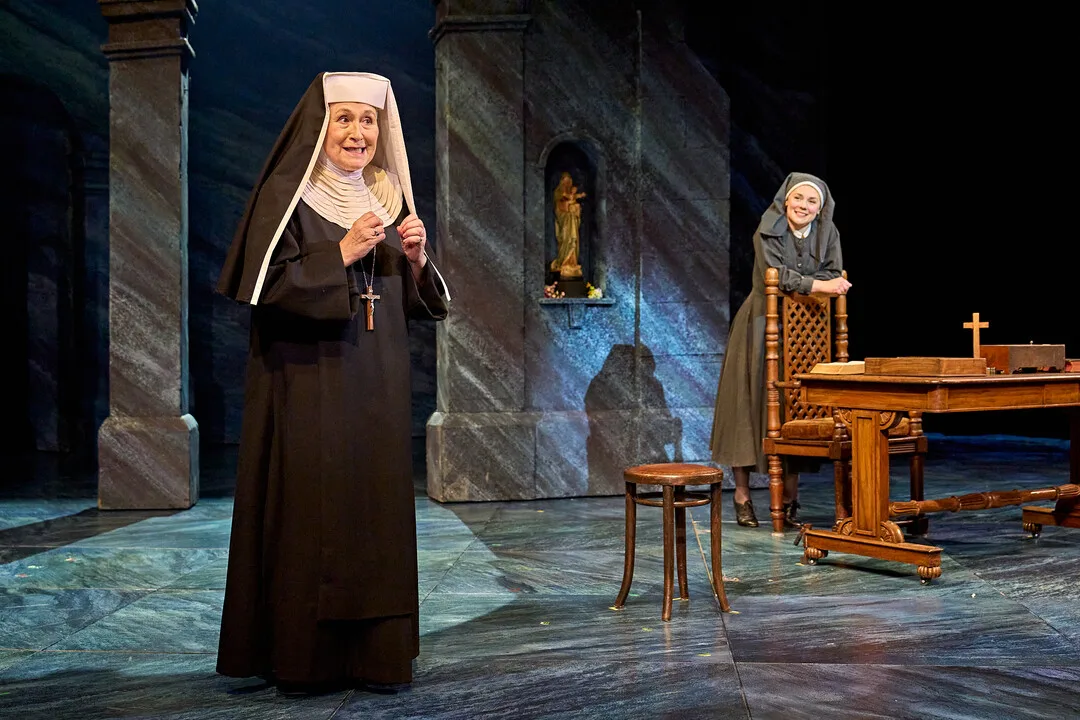
Natalie Ogle (Left) Elizabeth Elvin (Centre) Debbie Arnold (Right). Photo: Andrea Lambis

First published by Sardines: https://www.sardinesmagazine.co.uk/review/well-always-have-paris-2/

Venue: Jack Studio. 410 Brockley Road, London SE4 2DH

Credits: Adapted from Robert Louis Stevenson by Mark Stratford. Presented by Stratford Productions

The Strange Case of Dr Jekyll and Mr Hyde

5 stars

Susan Elkin | 28 Jan 2023 02:33am

With the possible exception of A Christmas Carol, Robert Louis Stevenson’s 1886 novella The Strange Case of Dr Jekyll and Mr Hyde is probably one of the most frequently adapted prose texts of all time. I’ve lost count of the number of stage versions I’ve seen over the years. Moreover this isn’t the first time I’ve seen it as a one man show – James Hyland and his Brother Wolf Company did it that way a few years ago. The novella is widely studied in schools too, often for GCSE, so that makes it a popular choice for theatre because teachers and parents will bring teenagers.

In Mark Stratford’s highly accomplished hands, though, it manages to feel freshly minted and that’s quite an achievement given that this is a tale everyone knows something about even if they haven’t read it. He uses Inspector Newcomen, investigating the death of Sir Danvers Carew as a framing device – gruff, rough and mopping his brow. Then he becomes the rather quiet, anxious, trustworthy, decent Mr Utterson the lawyer, who speaks in a soft voice with gentle RP vowels. Then there’s the Harley Street doctor friend whose accent is Scots. The story telling is as clear as it could possibly be.

Of course the reason it works so well with a single actor is because it investigates two extreme sides of the same personality. Stratford is initially urbane as Jekyll and pretty terrifying as the staring eyed, growling menacing Hyde – crouching to suggest a shorter man. “As Edward Hyde I was free to pursue all the activities denied tom me as Dr Jekyll” he observes in Jekyll mode, mentioning “undignified pleasure and precarious depravity”. We see him commit a gruesome murder, so convincingly mimed that we’re all wincing and we hear the screams of the terrified child he knocks over in the street. Other horrors are merely hinted at – after all Stevenson was fettered by Victorian censorship laws and Stratford’s adaptation is pretty faithful to the words the author used.

Stratford is a very talented actor. In the last few minutes, when the transforming drug is failing, he has to ricochet involuntarily between Jekyll and Hyde at speed and it’s dramatically exciting to watch. And I really admired his death scene complete with poison-induced involuntary twitches before he quietly gets up and resumes the Inspector Newcomen role to round off the narrative. Bravo, Mr Stratford.

The atmosphere is enhanced with some sinister sound effects and some evocative lighting. Both help to ratchet up the sinister mystery and struggle which lies at the heart of the piece.

This show is touring until June and is definitely one to catch if you possibly can.

First published by Sardines: https://www.sardinesmagazine.co.uk/review/the-strange-case-of-dr-jekyll-and-mr-hyde-2/


Venue: Golden Goose Theatre. 146 Camberwell New Road, London SE5 0RR

Credits: By Edward Bond. Presented by Four Points Theatre.

Have I None

3 stars

Susan Elkin | 26 Jan 2023 03:23am

Photo by Francesco Codardo


Edward Bond’s visceral, aggressive one act play may be 23 years old but it has lost none of its forceful oddness.

We’re in a dystopian 2077 whose bleakness makes Orwell’s 1984 seem quite cosy by comparison. Families, memories and photographs are illegal. Mass suicides are an everyday occurrence and the old cities are in ruins so depersonalised people are re-housed in regimented suburbs.  Furniture is reduced to a government issue table and the right number of chairs which, incidentally, makes this play pretty simple to stage.

The Golden Goose is configured more of less in the round (seating on three sides) for this production and director Lewis Frost makes neat use of the space so that all the action feels pretty immediate although sight lines aren’t perfect from where I was sitting.


Sara (Abigail Stone) and Jams (Brad Leigh) are miserably, angrily, violently married and at the opening of the play she sits alone at the table plagued by knocking at the door which may or may not be real. Then her appalling husband, who works for the security service, arrives home and soon shows his true colours as a shouty bully while she screams back at him. They fight over things such who has sat on whose chair and who left the tap on – the absurdity is often funny.

Then the dynamic shifts at the arrival of the relatively insouciant Grit (Paul Brayward) who claims to be Sara’s brother and to have walked the length of the country to find her. Visitors are definitely off limits so that’s a cue for a lot more fury and distrust.

Stone is good at mood shifts:  gleaming with unfettered rage in contrast to silent, glassy anxiety, for instance. Her dream scene is good too. She wears a blue robe to which rattly spoons are stitched. Then she reverses it to reveal bones sewn onto black fabric.  Someone must have had fun creating that.

Leigh – who has played Grit in this play before – stresses the gritty nastiness but manages to temper it with a shred of vulnerability and fear so that the character is just about plausible. Brayward’s performance is distinguished by the quality of his active listening, especially when the other two are shouting at each other over his head.

Yes, Bond is a great original but there are echoes in this play. The knocking reminds me very much of the Porter in Macbeth and the misfired poisoning at the end is almost straight out of Hamlet.

Have I None is an interesting piece of drama but it’s relentless and I wasn’t sorry it runs 50 minutes rather than, say, a couple of hours.

First published by Sardines https://www.sardinesmagazine.co.uk/review/have-i-none/


Somewhat late to the party, I saw Hamilton last month. Like everyone else, I admired its originality, ensemble work, story telling and concept – with just a minor caveat or two. I was also forcibly struck by how shamefully little I know about the early decades of American independence after the Revolution.

My theodosia

I was, however, familiar with the name of Aaron Burr, Jefferson’s vice-president who shot and killed Hamilton in a duel.  And that was because, decades ago, I read Anya Seyton’s 1943 novel, My Theodosia – the story of Burr’s, beautiful, accomplished daughter who died at sea aged 29 and no one knows quite how or why. Seyton, of course, shows us exactly what happened. It’s speculative fiction. And rereading it now, I’m satisfied that her suggestion is as valid as any other although, as far as I can tell, there’s no historical evidence linking her to Captain Merriwether Lewis governor of Missouri Territory who led an expedition into the “wild country” after the Louisiana purchase of 1803.

Theodosia has an exceptionally close relationship with her charismatic, widowed father who owns a beautiful estate in what is now Greenwich Village. Despite her having fallen mutually in love at first sight with Merriwether at the theatre, she is soon married to Joseph Alston, a wealthy South Carolina rice plantation owner:  a marriage of convenience.  Aaron Burr’s problem is living beyond his means along with, ultimately, absurd delusions of grandeur. He milks Joseph, of whom Theodosia becomes mildly fond, for money and gradually gets into serious, impoverished debt. Moreover there’s a court case, and a spell as a prisoner on remand, relating to the alleged murder of Hamilton.  But his daughter never loses her faith in him even when he goes into exile in Europe.

It’s tightly, carefully plotted and if, like me, when you read a historical novel set in an unfamiliar place and/or period you keep thinking “Really?” and reaching for Google,  you find that nearly all the big issues, places, people and events in this novel are well researched and factually pretty accurate. I enjoyed some of Seyton’s depiction of historical figures such as Thomas Jefferson and Dolly Madison too.

Some 2023 readers, though, will find My Theodosia an uncomfortable read. Theodosia travels hundred of miles south to live on a hot, swampy, unhealthy plantation in the last years of the eighteenth century. Obviously it runs on slave labour. Joseph’s family owns all the plantations for miles and have literally hundreds of slaves. Of course the Alstons casually use the language of slavery including many wince-inducing words. Whatever any of us might think now, that’s how it was. At the time, in that situation, the language was often simply descriptive rather than perjorative. Theodosia, as a northerner, makes it quite clear that she doesn’t approve of slavery and treats most of ones she gets to know reasonably decently but even she uses the same language – and refuses point blank to use a slave midwife, whose methods are all based on lucky charms, or a black nurse when her son is born. In a way though, Theodosia’s objections, highlight the horror of the slavery system especially when it comes to a pretty young woman named (appropriately as it turns out) Venus.

I’m not sure that a publisher would have the courage to run with this today if it were submitted as a new manuscript because there would be fears that blinkered people would simply see the language and not think through the issues – rather as many did with Lady Chatterley’s Lover.  1943 was a long time before Black Lives Matter, after all. Actually, I think if you look at My Theodosia carefully and open-mindedly you will, I hope,My theodosia2 agree with me that the presentation of the slavery issue is pretty sensitive – with Theodosia’s attitude continually contrasted with Joseph’s.

Next week on Susan’s Bookshelves: Giovanni’s Room by James Baldwin


Show: In the Net

Society: London (professional shows)

Venue: Jermyn Street Theatre. 16b Jermyn Street, London SW1Y 6ST

Credits: BY MISHA LEVKOV. PRESENTED BY WOLAB. DIRECTED BY VICKY MORAN.

In the Net

2 stars

Image: Anya Murphy, Carlie Diamond In the Net. WoLab. Photo: Steve Gregson


Misha Levkov’s new play takes us to London in 2025. Drought is a serious issue affecting every household, prices of everything are rising continuously and there’s a new mantra: “When the water goes the refugees come”. In the midst of all this two half sisters and the Syrian woman who is staying with them come to believe that things will be better if they create an “eruv” – an area which symbolically extends Jewish territory and permits Jewish people to disregard their own rules. In practice this means building a complex cats cradle of string across the stage, visually intensified by Jonathan Chan’s lighting and Daniel Denton’s projection. Meanwhile their decent father is bemused and local council furious.

The symbolism in all this is abstruse to put it mildly and the wordiness of the action-light play does nothing to clarify it. The play makes some pertinent political points about refugees and climate change but eruf is not a successful device in this context and we don’t understand it anymore than the council committee meeting does.

The other problem with this play is that it is trying to do far too much at once. Laura (Carley Diamond – good) is grieving for her mother who has just died but the theme is never developed. Hala (Suzanne Ahmet – powerful) has arrived in Britain on a refugee boat and that’s a story in itself. The best scenes in In the Net are between her and the very versatile Tony Bell who is outstanding as a sinister immigration officer.  Finally there’s a drought so serious that households are rationed and when someone deliberately pours the water away it’s devastating. I’d quite like to see a play focused on that.

All this is a great pity because five accomplished actors, who have clearly worked very hard on this show, are let down by the material they’re working with. It’s meant (I think) to be a play about struggle but the tension shouldn’t be between the actors and the text.


 First published by Sardines: https://www.sardinesmagazine.co.uk/review/in-the-net/

When I was at teacher training  college having a lovely time but not learning much about how to teach, one of the things they made us do was to create a book – not write one but create it as a craft exercise. And we could choose what to do or how to do it. Airy fairy stuff but I went off quite happily aged 19 to do this primary school task during the summer holidays – although I couldn’t see quite what I was going to gain or learn from it.

I’d found the books by Iona and Peter Opie in the college library and thought the history of nursery rhymes was interesting. So that became my hand-written book topic. A friend did the illustrations and most of the information came from the Opies. I didn’t get much of a mark for it although I really had tried. I’m simply not good at anything to with art and practical craft. The whole project, however, did teach me to view nursery rhymes in a different light and I’ve remained intrugued.

So imagine my glee when I discovered just before Christmas that Tim Devlin has just published Cracking Humpty Dumpty. His strapline is “an investigative trail of favourite nursery rhymes” and, a former journalist and then PR man, he really has applied his well honed professional research skills.

In fact he has debunked everything I thought I knew about nursery rhymes. Of course Ring-a-ring o’ roses isn’t really about the plague. It’s not mentioned in any of the contemporary sources or in respected historical accounts of the plague years. Rather the earliest references to it date from late 18th century Massachusetts in a  game version a bit like musical chairs. The plague link stems, it seems, from a nineteen fifties book by James Leasor, a man with a colourful imagination. But the public liked the link and it soon became received truth particularly since the famous plague village, Eyam in Derbyshire understandably capitalised on it for tourism reasons. Fascinating stuff.

And we all know that “Little Boy Blue” was Cardinal Wolsey don’t we?  Well hang on, he was a cardinal why wasn’t it Little Boy Red?  Moreover, Wolsey was a very hard worker and not known for nodding off on the job.  There is another theory that the eponymous lad was Charles II but a very similar rhyme in Shakespeare’s King Lear written over 50 years earlier refutes that. Or was it simply an unloaded comment on children who often guarded livestock on common land in the centuries before the enclosure acts? Sometimes the truth is much more straightforward than the fanciful interpretations commentators try to make fit.

Devlin investigate twelve rhymes in detailed depth. He writes smoothly and entertainingly but his book is packed with information. He has consulted dozens of books and other resources dated from 1837 to 2019 and spent hours in libraries and at relevant sites all over the country. It’s a pleasantly tactile book too in a nicely designed format by his publisher, Susak Press. The paper is shiny, the font a clear sans serif and the 190 x 240mm size slimly neat.

Katarina Dragoslavić’s  warmly attractive illustrations are the icing on the cake. She nails the essence of Devlin’s arguments with a plate at the head of each chapter to which he often refers in the text.

The good news is that a sequel is in preparation. It will feature a further twelve rhymes and Devlin is inviting suggestions about which other rhymes he might investigate in the future.

At the time of writing, this excellent book is not available via Amazon although Devlin is hoping that it soon will be. Meanwhile you can purchase it via the website www.humptycracked.com.

humpty+square+cover+new

Next week on Susan’s Bookshelves: My Theodosia by Anya Seyton


Show: You Can’t Understand

Society: London (professional shows)

Venue: The Jack Studio Theatre. Brockley Jack, 410 Brockley Road, London SE4 2DH

Credits: By India Wilson. Produced by S.L.U.G. Productions

You Can’t Understand

3 stars

It’s always encouraging to see a talented young actor performing her or his own work. India Wilson, who comes from Bermuda, graduated from Mountview with an MA in Acting in 2021 and You Can’t Understand was initially developed during her training. It’s a one-act play which runs just forty-five minutes – ten minutes less than advertised.

The piece – with a lot of humour and flirty audience participation alongside some serious issues – explores the identity of a mixed race child/teenager named Kika at different stages of her young life. There are several characters and, because this is a one-woman show, Wilson plays them all – with plenty of versatile flair. I especially liked her take on Kika’s white Welsh mother and on Murray the grunting, deep-voiced, taciturn boy that the slightly older Kika crassly throws herself at. She does a great deal of leaping the length of the centre stage bench to convey conversation between two people, in the time-honoured way.

The writing is strong but I was less impressed by the dance and mime sequences. Yes, when Kika’s in a ballet class and annoys the teacher by insisting on doing her solo piece with her own inappropriate (by that class’s standards, anyway) choreography you need to see some dance. But at other moments it seems like a way of stretching the action and there’s a mime scene in which (I think) she’s meant to be  having sex with Murray – but that’s not an easy thing to evoke on your own and it’s unconvincing.

Francesca Solomon, lighting designer and operator, deserves a few plaudits. Her work is imaginatively atmospheric and makes Wilson – at one point in white make up and lipstick, which she has asked an audience member to apply, smeared grotesquely all round her mouth – look quite vulnerable.

This play certainly has potential but at present it feels like work in progress.

First published by Sardines https://www.sardinesmagazine.co.uk/review/you-cant-understand/

Show: Allegiance

Society: London (professional shows)

Venue: Charing Cross Theatre

Credits: Music & Lyrics – Jay Kuo Book – Marc Acito, Jay Kuo & Lorenzo Thione. Produced by Sing Out, Louise! Productions

Allegiance

4 stars


When I was a teenager I saw Sybil Thorndyke, Edith Evans and Lewis Casson in Arsenic and Old Lace. When the latter, who must have been in his late eighties, first entered down a staircase he got a respectful, thrilled round of applause. You don’t see or hear that very often but it’s what happened to George Takei, 85, first took the stage at the opening of Allegiance, now running in London for the first time. Yes, this veteran actor is fulfilling a lifelong ambition to be on stage in London and is doing it with dignity and aplomb.

It’s a very attractive, quite traditional musical – more Rogers and Hammerstein than Sondheim with some of the most powerful story telling I’ve seen in new musical theatre for a while. After the Japanese attack on Pearl Harbour in 1942 all Japanese Americans, many of them born in the US, were rounded up, deprived of their property and assets and put in pretty primitive internment camps hundreds of miles away. And for a long time they were not allowed to enlist. This is a shameful, shocking bit of history which, until now, few people have been aware of and it hits especially hard in this show because it reflects Takei’s own story. Born in Los Angeles to a Japanese immigrant father and an American born but Japanese-educated mother, he was 5 when they were arrested at gun point and incarcerated in various concentration camps for the rest of the war.

Takei plays two roles. In the framing device he is a very elderly war hero, Sam, being told that the sister he’s been estranged from for decades has died. Then at the very end he learns the identity of the messenger and has many audience members reaching for tissues. In the central 1940s flashback Takei plays the family grandfather while the excellent Telly Leung gives us the younger Sam. Both roles are very old men and Takei is, obviously, convincing. He has a strong voice, both spoken and sung, and a nice dead pan way of delivering jokes to his loving family who’ve heard them all before. It’s a very warm performance

He is well supported by a talented cast of 14. Amongst these Aynrand Ferrer is outstanding as Sam’s sister Kei – she sings with strength, passion, terrific intonation and her full belt is quite something. She also creates a totally believable character who cares, worries, falls in love and is devastated by the estrangement from her brother.  There are noteworthy performances from Megan Gardiner as the nurse in the camp and from Patrick Munday as Kei’s boyfriend, Frankie, who makes different choices from her brother. The marriage proposal duet sung by Ferrer and Munday is especially beautiful with appropriate close harmony.

Charing Cross theatre is configured, for this show, with raked audience seating at both ends and a square playing space in the centre. Director Tara Overfield Wilkinson, who also choreographed the show, makes excellent use of the space so that every inch of it is used to naturalistic effect.

The band, which plays beautifully, is led by Beth Jerem on a balcony overlooking the stage. Lynne Shankel’s orchestrations give us plenty of ethereal Japanese-style flute work and I was faintly amused at  composer Jay Kuo’s use of the pentatonic scale to connote a Japanese vibe in “Wishes on the Wind” when the whole cast is at prayer. It’s a simple time-honoured trick but it works every time.

There’s a lot of stage smoke (liquid carbon dioxide) in this show. It is used, quite effectively. to suggest the dreadful dustiness the internees have to deal with in Ohio. I know it isn’t supposed to have any adverse effects on anyone but I’m afraid it makes me cough – and the audience is pretty close to the action in this show. It’s a minor gripe, though.

Love, forgiveness, reconciliation – they’re all here in abundance and that makes Allegiance a very heart warming experience.   I hope Takei gets that welcoming applause at every performance. It’s well deserved