Press ESC or click the X to close this window

Meet Lou Stein, artistic director of Chickenshed Theatre

Chickenshed Theatre, Southgate. Lou Stein is the new artistic director of Chickenshed.

Chickenshed, whose slogan is “Theatre changing lives” is an inclusive theatre company in north London which also runs further and higher education courses. Since 2000 it has established 19 “sheds” in the UK and two in Russia to develop inclusive theatre elsewhere. Susan Elkin talks to Lou Stein who took over as director in April.

What did you do before you came to Chickenshed? I was born in Brooklyn, New York City. I’m not going to tell you when but I’m younger than Hilary Clinton. I trained at Northwestern University (Bachelor of Science Communications), University of Iowa (Master of Fine Arts in Theatre Directing) and with BBC Training (TV Director’s Course, 1992). I’ve been Freelance through my own company since 2000. I was Artistic Director at Watford Palace Theatre from 1986 to1995 and, before that, Founder/Director at The Gate Theatre from 1979 to 1985.

Many people associate Chickenshed with disability but that’s misleading isn’t it? Yes, I want to stress inclusion. Some Chickenshed participants have learning difficulties and/or visually obvious impairments but many don’t. It’s a reflection of society as it is.

How do you plan to develop that though theatre? Chickenshed is going to be a confident, highly skilled professional company, staging unmissable plays. And for that I have the support of the entire staff of 70 full timers. It might take a while, but that’s where Chickenshed is headed. It has to present theatrically entertaining shows which people will flock to see. It’s theatre we’re creating not documentary. So I shan’t be doing anything earnest. Of course, at the same time, I want work at Chickenshed to explore interesting or controversial issues in a way which makes people want to talk about them afterwards. And I shall collaborate and build partnerships so that we can transfer some of our work into central London, although if it’s good enough audiences will come to Southgate too.

You mean you’re going to improve standards? Yes. I want to raise the bar and to do so systematically. First I need to take the staff with me. Everyone needs to understand that we are staging professional theatre and it has got to be absolutely first class. Then the people on the Chickenshed degree course and our Btec students will follow and everything will spiral upwards.

When did you first come across Chickenshed? My son Ethan, who is 9, has Down’s syndrome. He has been a Chickenshed member for five years and it was as a parent that I first became fully aware of Chickenshed’s way of working. You see, I understand just what a person like Ethan is up against. So many doors are closed but at Chickenshed he has been welcomed, treated by staff, and crucially other students, with love and empathy and the growth we’ve (Lou’s wife is the composer. Deirdre Gribbin) seen in him as a result is remarkable. Because theatre is my life, I wanted something theatrical for him to do where he wouldn’t be marginalised.

How difficult was it to get the job, as you’re the first new director since the company was founded? Yes, until now Mary Ward who co-founded Chickenshed in 1974, has been the artistic director so this is a big change and major new phase for the company. Even now Mary remains on the board. Perhaps it’s because of this background that the interview and recruitment process for the job was the most rigorous I have ever been through.

So how important is that history? It may seem a bit controversial but I am not actually that interested in the history. Of course the work that Mary and her co-founder Jo (Collins) have done here is what has made Chickenshed what it is and that’s terrific and very important, but my concern now is to move forwards and reach new levels of excellence. And to do that I need to keep a very clear and objective eye.

Chickenshed is a complex organisation isn’t it? Yes, it’s effectively a further and higher education college as well as a theatre. Chickenshed is a busy place because it operates on so many levels, something which is not fully understood by people who think it’s a youth theatre, producing house, a dance school, “a place for disabled kids”, or a further and higher education provider. In fact, of course, it is all of those and more.

What about lobbying? Lobbying for inclusion is like lobbying for air. We’re not going to do it because it’s just a fact of life.

What are you working on at the moment? It’s a new Oz story which I’m writing for Chickenshed’s Christmas show. There will be a group of associate directors whom I shall oversee and they’ll work with a cast of 800 in four cast groups.

And your longer term future? I am a person of possibilities. And I shall keep my own company Lou Stein Associates Ltd on the boil creating new work and new opportunities alongside Chickenshed.

Originally published in Ink Pellet, June 2016: http://www.inkpellet.co.uk/2016/06/a-day-in-the-life-of-lou-stein/
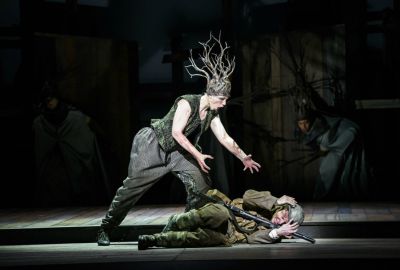
Welsh National Opera. Royal Opera House, July 1

2468_1467486960


The anniversary of the beginning of the Battle of the Somme was a poignant day on which to experience this powerful opera based on David Jones’s epic World War One book-length poem. Iain Bell’s lush lyrical score is melodious but, a

part from one or two set pieces, stops short of being tuneful. Instead, with hints of Britten, it evokes atmosphere and emotion. The colourful use of instruments adds a lot to the drama and it’s all in excellent hands under Carlo Rizzi with Welsh National Opera Orchestra in the pit.

Apart from two quasi narrators The Bard of Britannia (Alexandra Deshorties) and the Bard of Germania (Peter Coleman-Wright) and Andrew Bidlack as Private John Ball this is very much an ensemble piece. Baritone, Coleman-Wright brings terrific weight and gravitas to his role, Deshorties is gentle and moving as a mourner and exciting when she morphs into the Queen of the Wood dispensing death with random ruthlessness, Bidlack’s role epitomises the ordinary scared, chirpy Tommy – most definitely not a professional soldier and very much an everyman conscript. Bidlack makes him very moving.

WNO has invested in a magnificently large chorus for this production. When the men are marching they are convincing partly because of the size of the group. Their ensemble singing is impressive too. There is also a large chorus of women who

float in and out of the action but are not part of it. Symbolically, I presume, they represent mourning, lament and everything the men have lost although I overhead one audience member commenting in the interval that she didn’t understand what the women were for because everyone knows they weren’t there. In places it certainly takes a leap of imagination to make sense of what seems to be happening.

Full marks, though to designer Robert Innes Hopkins. His extraordinary set encloses the action in an oval space within the large ROH stage. Lowering and raising a semi screen in faux bronze with a grandiloquent inscription creates a huge elliptical expanse of sky on the back wall. This is flushed red for blood, grey for storm, black for night and at one point sports a lovely rising moon. There is also a neat transformation into an underground trench. And the costumes for the women when they morph into sinister twiggy bits of Mametz wood are a real tour de force.

It’s a compelling and very original piece of theatre. It was hard to see in theory, how In Parenthesis could be adapted into an opera. Librettists David Antrobus and Emma Jenkins have provided a fine way of working it and director David Pountney has more than developed it into something theatrically resonant.

Originally published by Sardines: http://www.sardinesmagazine.co.uk/reviews/review.php?REVIEW-West%20End%20&%20Fringe-In%20Parenthesis&reviewsID=2468

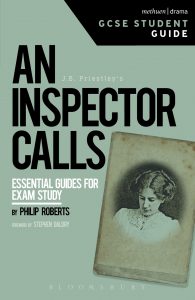
An Inspector Calls Sudy Guide

I’ve been studying the new GCSE drama specifications, once called syllabi, and talking to drama teachers. There has been widespread misunderstanding about what the new curriculum contains.  Rather than reducing the requirement for students to see live theatre, it has actually been increased.


There are four GCSE examining boards: AQA, OCR, Edexcel and WJEC.  Of these, until now, only one (Edexcel) made seeing live theatre a compulsory part of the course. That meant that roughly three quarters of GCSE students saw live theatre only if someone in their schools happened to think it was a Good Thing.


The new specifications are a great improvement. All four boards now include a requirement to see live theatre and they all specify that “live” really should mean live if possible. However, three of the four boards – AQA, WJEC and OCR –  allow digital theatre to be used instead if there is no other option.  News on the street is that that Edexcel will probably soon change its policy to come into line with the others too.


And that really isn’t unreasonable. Consider the student who’s ill and off for a term thereby missing the school trip or the school with high levels of deprivation tucked away in a remote rural spot. Or the school whose head will not allow students to come off timetable for anything – not even a practical exam – and trust me, they’re out there. Digital theatre is a great deal better than none and infinitely preferable to students being rendered ineligible for the exam by circumstances way beyond anyone’s control.


Of course live theatre is always the best option but surely it’s better for these students to see, say, an NT Live production in the local cinema for £10 or a high quality production streamed in their own schools than to be limited to a very weak, live local amateur production because the word “live” is interpreted slavishly?  It’s all the question of balance and common sense which is, unfortunately, not very common.


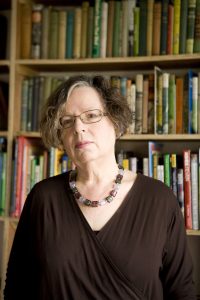
SUSAN ELKIN is enchanted by the multi-faceted and prolific writer Adèle Geras, still writing – at her own pace – at the age of 72.

Most interviewees elect to meet journalists on neutral territory such as a coffee shop, hotel or reserved space at a theatre or publisher’s. It is typical of the warmth and openness of novelist Adèle Geras that she invited me to lunch at her pretty home on the outskirts of Cambridge and plied me with a delicious homemade middle eastern salad.

Adèle has written dozens of books for children and young adults including Troy (published in 2000) which brings to life the women mentioned only peripherally in The Iliad and made it onto several book prize shortlists. In recent years she has also turned her hand to novels for adults. Her latest Love, or Nearest Offer is published by Quercus this month and is about an estate agent managing house moves and life changes for several people whose lives interact. Its flavour sits somewhere between Joanna Trollope, who eschews happy endings, and Katie Fforde who finds them irresistible.

Describing herself as a very secular Jew, Adèle tells me about her complicated cosmopolitan background, “I was born in Jerusalem in 1944” she says, adding that her mother’s family had lived there for seven generations. “My father was half English and half Moroccan because my grandfather was a merchant whose work took him to Morocco. “My father, who worked desperately hard at being more English than the Queen read law at Oxford and then his work took him to Jerusalem where he met my mother.”

Adèle grew up mostly in Egypt but was sent to boarding school in England when she was eleven after her father had joined the British Colonial Service and was variously posted all over the world. “I had passionate, dedicated teachers at Roedean where the notion that there was anything girls couldn’t do never entered anyone’s head. I am deeply grateful for my education.”

Having grown up in an environment in which nearly everyone spoke more than one language and trilingualism was the norm, it seemed a natural progression for Adèle to do modern languages – French and Spanish – at Oxford. “Although it wasn’t what I really wanted to do. I was determined to be an actress and wanted to go to RADA, but I promised my father I’d try applying for Oxbridge first. Actually, even before I got there, I’d realised that there was so much drama to take part in at Oxford that it was almost as good as vocational training anyway.”

She was neither the first nor the last Oxford undergraduate to spend so much time acting that her studies suffered. “Our play Hang Down Your Head and Die” went to the West End and got terrific reviews. I had prelims at the time so I was in exams all day and the theatre all evening before climbing back into St Hilda’s college in the early hours. The upshot, of course, was that I failed my prelims which was a dreadful disgrace”. She mentions other plays and other memories and points out how lucky she was to be at Oxford from 1963-1966 alongside Michael Palin, Diana Quick, playwright David Wood and many more.

In her final year at Oxford she hooked up with postgraduate student Norman Geras whom she married when she was 23. “Norm’s entire career was at the University of Manchester, first in a junior capacity and eventually as Professor of Government so that’s where we lived until he retired in 2003 – soon after his cancer was diagnosed” says Adèle who has two daughters, one of whom is the best selling novelist Sophie Hannah, and four grandchildren. Norm died in 2013 having become quite well known for his cutting edge Normblog on which he wrote about politics, philosophy, cricket, country music and the many other things which interested him.

So how did Adèle start writing? “I worked as a French teacher in grammar school because I couldn’t get acting jobs and we were skint. Then once I’d got Sophie we used to go to the library every day and like many parents I began to think ‘I could do better than this.”

So she entered a newspaper competition with misplaced confidence although it proved that she could get a story down on paper. Then, undaunted. she had over 40 rejections for books for very young children before she realised that these are almost impossible to sell without illustrations. Eventually she hooked up with Doreen Caldwell and together they did Tea at Mrs Manderby’s, for the Hamish Hamilton Gazelle series – having literally knocked on the door of many London publishers to show them their work. “Publishers and editors were so nice in those days” says Adèle. “I feel really sorry for young writers trying to get started today now that everything is so commercially driven and hard bitten”.

Many picture books and books for older readers followed. Adèle is an eclectic writer with many interests. She loves, for example, fabrics and is an accomplished designer knitter. Although she has now almost stopped writing children’s books since Dido in 2009 she has recently had published an exquisite miniature book – ideal for tiny hands – called The Dream Quilt (Long Barn Books) illustrated by Valerie Greeley who is herself a quilter. It tells the story of a child’s bedtime stories, dreams and imaginings.

About fifteen years ago Adèle, while in the midst of writing Ithaka with a contract and a deadline, suddenly had an idea. “And that doesn’t happen often” she says modestly. So she jotted down a couple of paragraphs about family members coming together in a house and continued to mull. Then she happened to be in her daughter Sophie Hannah’s house when Sophie’s agent rang. Naturally she asked after Adèle and on hearing that Adèle had an idea for an adult novel asked to see it. Having cleared it with her own agent, who specialises in children’s books, Adèle eventually – despite the nagging demands of Ithaka – drafted some samples which became part of a bidding war between publishers. “I ended up with a huge, really huge, advance and promises of film rights and so on. Of course it was lovely to have the money but I knew that Facing the Light would never earn that advance and I was right. So of course I get a smaller advance, but still respectable, for Hester’s Story and today advances are really modest.”

Adèle’s adult novels focus on family relationships and there are always interesting backstories which often pack quite a surprise. Her plots are not predictable. After the first two novels (there are six so far) Adèle moved from Orion to Quercus when her editor moved.

I ask her how she organises her working day. “Gently” she laughs. “If I have a book on the go I reckon to do about two hours a day, often from 5-7pm. That produces around 1000 to 1500 words a day and it builds up quite steadily if you stick at it. But I work at my own pace and I don’t have fixed deadlines. I take the view that at 72 I could be completely retired so any work I achieve is a bonus.”

Otherwise she enjoys life. During the course of our conversation she mentions attending knitting workshops at John Lewis in the city centre, leading the occasional writing workshop, writing a “quick read” book aimed at people such as prisoners who may be reluctant to tackle anything too long, enjoying music and television, running her website History Girls, spending time with her many writer friends and with family and, of course, reading a lot. She mentions so many writers and books as we chat that by the time I leave my TBR (“To Be Read”) list is nearly as long as hers.

Beneath her kind, appealing and faintly scatty manner, Adèle is of course a serious thinker who has an opinion about everything. Her views are generally liberal but rigorous. She has, for example, disconcerted her friends by expressing admiration for Michael Gove’s attempts to raise standards in education and more recently to improve conditions for prisoners by, for example, granting them more access to books.’

I leave Adèle’s house feeling quite sad that this interview is over. In three hours we have ranged over many topics, ideas and views. I drive away with my head brimming over with colourful impressions from her childhood in the middle east to treading the boards in Oxford, London and Edinburgh. Or the image of her chatting to the eponymous Hamish Hamilton and being disappointed when he gave her a book instead of the promised three Pound fee at a time when she desperately needed tights. Then there is the time she did a book signing session alongside Sophie Hannah because the image of mother and daughter together is novel. Yes, the word “multi-faceted” might have been coined for Adèle Geras.

This interview was first published in Ink Pellet AdeleGerasLargehttp://www.inkpellet.co.uk/2016/06/cosmopolitan-writer/
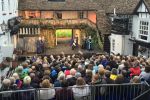
The wind seems to be howling and there’s a lot of noise, shouting, atmospheric writhing and a sense of danger.

Then Marcus Ayim, his purple velvet cloak swirling, holds up a cane and suddenly there’s quiet as he frowns and takes control. This is Malmesbury Primary School, Morden, and its production of The Tempest.

Children from years 4, 5 and 6 are evoking the titular storm with their voices and bodies. Marcus is Prospero and there is a trio of Ariels in white hoods over their professional, actor-like black tights and tops.

Read the rest of this article in The Daily Telegraph http://www.telegraph.co.uk/education/2016/07/02/shakespeare-schools-festival-rough-magic-brewing-in-sutton/


30 June, Courtyard of George Hotel, Huntingdon

2465_1467368231

Lynne Livingstone’s lithe, quavering Ariel wafts continuously as if she were a strand of rippling seaweed: ‘full fathom five’ indeed. She sings the songs with lyrical sweetness and gives us a pretty scary harpy. It’s a memorable performance and it’s a directorial (John Shippey) inspiration to surround her with four subordinate spirits because it means the Ariel voice can come from different angles for the confusion of other characters. It’s all very otherworldly and sets the tone for an interesting production.

Martin Woodruff takes a while to warm up as Prospero and presumably it was heighted stage fright on “VIP night” which triggered no fewer than three separate ‘dries’. In the second half, though, he finds the authoritative dignity the part requires and all the set piece speeches are moving.

Among other notable performances is Richard Sockett whose drunken, self-interested larger-than-life Stephano is very strong indeed. Liz Barka is funny as a rueful, comical Trincula lusting after Stephano who fails to notice, And Richard Brown’s dirty, bowed, bullied Caliban never lets us forget that this play is partly about oppression and abuse of power. The three are a joy to watch together because each listens to, and plays off, the others with commensurate professionalism.

The trouble is that the comic romp scenes are so strong that other scenes sometimes seem dull, especially the ones featuring the shipwrecked nobles which drag a little. Having said that, though, it’s good to see some healthy gender blind casting giving us Queen Alonsa and Antonia. It changes the dynamic which makes for fresh interest.

Also very encouraging is India Barton in her first Shakespeare role as Miranda. She speaks the verse with intelligent elegance and gets just the right blend of pretty innocence with excitement when she first sees her Ferdinand (James Barwise – suitably dishy).

The Jacobean courtyard at The George, festooned on this occasion in garlands with a scenic artist’s copy of Rousseau’s Storm in a Tropical Forest at the very back, is – as always– an ideal setting. It manages to be both intimate and immersive without ever being gimmicky. I’m already looking forward to Pericles next year and Richard III in 2018.

 Originally published by Sardines http://www.sardinesmagazine.co.uk/reviews/review.php?REVIEW-Shakespeare%20at%20The%20George-The%20Tempest&reviewsID=2465


26 June, Bristol Old Vic Theatre School in collaboration with Bristol Old Vic

2453_1466974001

Bristol Old Vic, currently undergoing major renovations so that getting into the auditorium is a subterranean adventure, is celebrating 250 years as a working theatre. Bristol Old Vic Theatre School is 70 this year and of course it originated at the theatre although it has long since been a completely separate organisation. The two are now collaborating again and this fine King Lear, directed by BOV’s artistic director Tom Morris, is a shared venture to commemorate both landmark anniversaries.

Three top-of-the-game actors work with a large cast of BOVTS students and mentored creatives. That means that actors get a masterclass at every rehearsal though working with Timothy West, Stephanie Cole and David Hargreaves. It also means some imaginative designs such as animal masks for the chorus of cast members who provide chorally sung atmospheric sound effects with rhythmic stamping and sand drums and so on for the storm. And there’s an absolutely delightful massive chandelier made of antlers. The piece is in modern dress but the ambience is timeless.

The West/Cole partnership as Lear and his fool is genius casting. The pair have clearly been together for a long time. They pat each other’s hands, share private jokes and establish a comfortable rapport which is almost spousal as Cole stomps about in her oversized coat and eccentric hat.

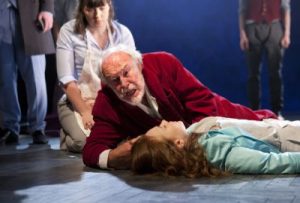
West is a very fine Lear, clearly showing signs of alarming volatility – “full of changes” as Goneril observes – from the very first scene in which he shifts from amiable authority to deranged irrational anger. And suffering from an “abatement of kindness” he has a way of bringing out the most poignant of lines. He is terrific in the storm scene, especially with Tom Byrne as Edgar pretending to be Poor Tom. Byrne, incidentally, makes a good fist of a very challenging role because Edgar is so rarely himself. At the last when West staggers in with Poppy Pedder (strong, particularly in the reconciliation scene) as the dead Cordelia in his arms his final lines are devastatingly moving. Both my “plus one” and I were weeping as the lights finally went down.

Hargreaves gives us a very plausible, gullible but decent Gloucester and the eye gouging is, inevitably, appalling. Dylan Wood as the amoral Edmund, plays him as a sardonic Scot whose direct-to-audience appeals are very convincing. He finds the right charisma to persuade us that both, yes, Goneril (Jessica Temple) and Regan (Michelle Fox) probably would both be lusting after him. Temple – who has a whiff of Jessica Findlay-Brown about her – develops real stage presence as Goneril grows grows ever more ruthless.

This is one of the best student productions I’ve seen in some time. It is clear that working alongside professionals raises the bar and it would be good to see more of this sort of thing. And why did it take this production to make me realise that actually, King Lear, is just a warning to think very carefully before granting of enduring power of attorney to your loved ones…?

Originally published by Sardines http://www.sardinesmagazine.co.uk/reviews/review.php?REVIEW-Bristol%20Old%20Vic%20Theatre%20School%20(student%20productions)-King%20Lear&reviewsID=2453

26 June, Polka Theatre Wimbledon, 240 The Broadway, London SW19 1SB

2454_1466975327

This little show exudes charm, looks and sounds attractive and comes well loaded with lots of messages for the tiniest theatre goers. And it sits happily in Polka Theatre’s intimate studio space which is aptly called the Adventure Theatre.

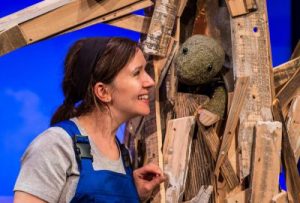
Rosanna Lowe’s 40 minute play has a classic three act structure, Chester, the tree mole (a rather amorphous long armed green puppet with mole-style paws) wakes, he has adventures in Woodland World, then he goes back to sleep. The middle “act” consists of a series of scenes in which Chester meets and tries to play with the other animals in the sanctuary including a spider, ants, snails, bats, an owl and butterflies. It’s a nicely scripted piece – although repeated overuse of the word “extraordinary” is an irritant – which teaches children a fair bit about animals. Bats are nocturnal. Ants carry bits of leaf. Snails get friendly and produce little snails.

The puppetry is delightful and the shy, languorous velvety snails (designer Robyn Wilson-Owen) are particularly inspired. Amy Tweed puppets Chester, in this three hander – and gives him a rather splendid idiolect by changing consonants in words. Clare Fraenkel gives her character – usually the one to offer mother-to-child style advice to Chester – a very plausible and pleasant manner. Sanjay Shelat is good as the man in charge of the sanctuary as well as doing much of the puppetry and playing the ukulele.

The quite neat subtext of this play – which stops short of being clunkily worthy – is that Chester behaves more like a child than a mole. He skateboards and goes flying in a toy aircraft. He is also noisy, sometimes rude and has to learn how to behave conformably and to think of others. At one point he says sorry too. Plenty to absorb, then for the very small children who see it.

2454_1466975351

Originally published by Sardines http://www.sardinesmagazine.co.uk/reviews/review.php?REVIEW-Polka%20Theatre%20(professional%20productions)-Chester%20Tuffnut&reviewsID=2454