Press ESC or click the X to close this window

No Lie They Fly (Daft Essays no 4)

Flying squirrel

Most birds fly. So do insects and bats. But did you know that some squirrels, lizards,  frogs  and snakes have also taken to the air?

Remember Dumbo the flying elephant? And we all know about all those wonderful things which might happen when pigs fly. Well, take a stroll in the jungles of Borneo next time you’re passing that way.  You won’t – unless you’ve had a drop too much of the local date brandy or palm wine  –  see pigs and elephants defying gravity  but you could well see a squirrel gliding thought the air.

Soaring squirrels

The aeronautical squirrel – address him as Petauristinae if you’re feeling formal – lives with his mate in a hole high up  in some tall tropical tree. He’s a handsome guy wearing a rich russet fur coat which looks as if was bought for a bigger chap.  In the late afternoon he and his wife scamper out for a bit of exercise – running along the bark  using their needle sharp claws like rock climbers’ pitons.

Then they begin to circle the tree trunk frenetically, Suddenly and quite unexpectedly the pair of them take off, first one and then the other  like a two part squadron.  Together they glide effortlessly and silently up to 35 yards through the air toward the next tree.  During the flight all four limbs are stretched out tightly and  the baggy overcoat  reveals itself as a useful  flat membrane attached at  wrist and ankle.

They  have evolved  fairly  light bones and  their ‘flight’ is a way  of moving from tree to tree in a dark  forest hundreds of feet below the leafy canopy  where the long trunks are  straight and lower branches are few and far between.   It’s really more  of a supported  jump – similar to hang gliding – than to true flight.

The aerodynamics are effective The fat furry tail is  a good rudder. So steering looks after itself. Once Mr and Mrs Squirrel are  within striking distance of the landing stage they  swoop sharply  upwards. Thus they hit the trunk running and can gallop away into the forest canopy  like aircraft touching down on  a vertical  runway.

Gliding  lizards

In the same forest you might chance on Draco, the flying lizard. His hang-gliding mechanism consists of a couple of neat  of flaps  of skin which  stick out from either flank, furled in like roller blinds against his body. They are stiffened  by  bony rib extensions evolved for the purpose.

When he gets the flying urge he pulls his ribs forward. That yanks the ribs apart and  distends the flaps like and aircraft swivelling its wing flaps. Take-off sends Draco  gliding cheerfully from liana to liana and from branch to branch. From underneath the flying flaps  look like huge diaphanous insect wings.  It’s a lot quicker – and safer because most predators can’t get at you if you’re air-borne – than landing  on the forest  floor and skittering across  to another tree.

Frogs aloft 

Keep an eye 0ut for flying frogs too. Not many frogs have parachutes on their feet but Rhacophorus does.  Extra long toes mean that the webbing he generally uses for fast swimming has evolved to be  much larger than that of his common-or-garden froggy cousins.

When he leaps  he can cover considerable  distances  because his mega-webbing keeps him air-borne.  It means that  he can get from leaf to leaf without putting himself  at risk or using too much energy as he goes about his amphibian  business in the tropical forests of Borneo.

Volitant (now there’s a nice word!) snakes

Chrysopelea, the flying snake,  is such a strange beast that for a long time no one believed in him. He was dismissed as a delusion invented by over enthusiastic early  explorers. But he’s real enough.

He’s a small, thin, quietish sort of serpent, although very beautiful with greenish- blue scales flecked with gold and red. Most of the time he whizzes skilfully  up and down vertical tree trunks at top speed.

When he fancies  piloting  himself across to another tree for a change of scenery  he races along a branch and throws himself off.  In the air he flattens his body like a piece of  ribbon which catches the air and enables  it to travel  much further than if it just fell.  The physics are neatly evolved because  most snakes’  bodies are cylindrically rounded.  In ‘flight’ or glide the snake wriggles his  flat length into a series of curly coils which gives him a bit of control  over direction and landing site.
 

2545_1472313431

Faction Theatre

Part of Refashioned season at Selfridges

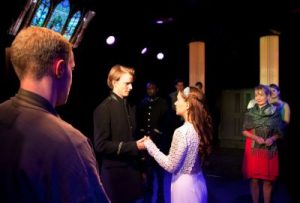
Caroline Langrishe is a pleasure to watch as Leonata in this pared down, reordered 90-minute Much Ado About Nothing. Every inch a strong woman, Langrishe portrays an authoritative head of her household when she needs to be but in other moods her Leonata is quite capable of girly laughter behind the scenes. It’s a neat feminist take on Leonato, usually played by a man as Leonato.

The famous sparring scenes between Daniel Boyd’s charismatically funny Benedick and Alison McDonnell’s Scottish, angry, sad but witty Beatrice work pretty well too. Director Mark Lepacher makes sure that everyone, except the two of them, knows they’re in love from the outset – and that doesn’t always come through in productions of this play.

There are two main plot strands in Much Ado. There’s the setting up of Hero (Lowri Izzard – nice debut) as a loose woman who is therefore jilted at the altar by Claudio (Harvey Lister Smith – boyish and he does distress well) alongside the getting together of Beatrice and Benedick. This production, set in the present, balances the two well enough but the malevolence of Don Jon doesn’t make sense in a modern setting. Simply being the bastard brother and therefore evil doesn’t feel truthful in 2016.

In principle it’s a good idea to use great actors (Meera Syal, Simon Callow and Rufus Hound) as news reporters and commentators on over stage TV screens. But if you don’t (can’t?) synch the sound track then it’s best not to do it. In the event this is the weakest part of this production and makes it feel very amateurish. It’s a shameful waste of the talents of the actors concerned and I should think they’ll be horrified if they get along to Selfridges to see the show.

The temporary space on Selfridges lower ground floor is a thoughtfully designed traverse playing space with 122 seats and it is an interesting idea for a Shakespeare festival, I suppose, although I can’t help wondering quite what it’s setting out to achieve other than publicising an already famous department store.

First published by Sardineshttp://www.sardinesmagazine.co.uk/reviews/review.php?REVIEW-West%20End%20&%20Fringe-Much%20Ado%20About%20Nothing&reviewsID=2545

SecretGardenWebImage

If your child or teenager wants (or needs) part-time performing arts training you will, almost certainly have to fork out quite a lot of money. I’ve been googling to get an update. Yes, there are a handful of bursaries and scholarships but the basic Stagecoach fee for a teenager is £330 per 12 week term. Pauline Quirke Academy charges £88 per calander month for a 44 week year which averages out at £352 per term. Razzamataz costs £234 per term and tries as far as possible to coincide with local school terms so that’s probably about 38 weeks a year.  Yes, I’m sure the hourly rate (typically three hours per week – triple threat) is excellent value in all these cases but if you haven’t got that sort of money, in most cases, your children can’t have it.

Unless, that is, you work with Matthew Garcia Chandler and British Theatre Academy which is trying to do things differently by offering many hours of free part-time training. It achieves this by mounting fine shows which more or less cover their costs and help to offset the school’s expenses. I urge you, for example, to get along to Ambassadors Theatre to see The Secret Garden which really impressed me with its professionalism and talent http://musicaltheatrereview.com/the-secret-garden-ambassadors-theatre/. Chandler tells me proudly that that the show has had lots of other 4* reviews too.

Not that Chandler has always had it easy by any means. He trained as an actor (Italia Conti and a year at GSA) but only ever wanted to run a drama school. He founded Songtime in 1989, charged fees like everyone else and then came perilously close to bankruptcy in 2010 when recession bit and many parents had to pull their children out. He relaunched as Act Now in 2011 but continued to charge participants. Then, two years ago came a new idea and a new name. “I wanted to distance myself from the franchise schools and find a new way of working by making participation free” he tells me adding that Annie which he did last year went to Sutton, Hayes (Middlesex), Guildford, Bracknell and other venues. “It sold out everywhere we went and made a profit so we were able to build up a pot of money to finance other ventures”. BTA also did 44 successful performances of Annie at the West End’s Arts Theatre last year.

“I have to keep this thing going for the children” says Chandler declaring firmly that BTA is no vanity project. He doesn’t take a salary out of the business. “My husband has a good job and is very supportive so he pays the bills at home” Chander smiles, joking that in Stephan Garcia, he’s found his Prince Albert or Dennis Thatcher.

“I’m not in this to make money out of children” he declares mentioning the stress on profits elsewhere. “And I’m scrupulously honest with parents about their children’s abilities. It’s never a case of write me a cheque and I’ll tell you what you want to hear.”

And that really is a different emphasis from many schools which operate as businesses.  Trying, for example, to woo new franchisees, Stagecoach website refers to “potential to make a significant income”. Razzamataz simply says “Great earning potential!”.

Children who train with Chandler at his Isleworth base are given the opportunity to audition for the shows. The Secret Garden has rotating casts totalling 359 children and young actors under 23. There are 200 youngsters involved in the version of Godspell BTA is doing in St Paul’s Church, Covent Garden on 31 August.

Around 10% of Chandler’s youngsters currently go on to vocational training and he’d like to increase that figure. Others go straight into the industry. Over the years he has trained some, now, very successful performers such as Charlie Brooks. The majority, though, simply have fun, learn discipline and team work and get that all important confidence boost.

Of course there are many valid ways of training and what works for one won’t necessarily work for another but BTA certainly seems to be developing a refreshing alternative to the usual deal. Chandler is currently looking for ways of extending his idea nationwide and is in the process of turning BTA into a registered charity.

2538_1472053976If we accept that the appalling problems of the war-torn Congo are entirely the fault of European colonisers all the way back to the Portuguese in the 14th Century, the next question is what do we do about it now? Is it better the mount a festival in London with poetry and music to build awareness or should we work directly with, for example, the 12% of all Congolese women who have been raped? That is the tension which lies at the heart of Adam Brace’s ambitious new play.

Well, it has its moments and strengths. Most of the play is set in London but the first half ends with a pretty riveting scene in the Congo in which the floor of the in-the-round playing space opens (lovely work from designer, Jon Bausor) to reveal a hot, busy, ruthless mine producing the minerals for western technology. It’s followed by a gentle domestic scene in a quiet hut which is then dramatically – devastatingly – disrupted as the real horror of life for many Congolese is graphically revealed. Meanwhile Giles Thomas’s sound track does clever things to evoke the sounds of Africa so colourfully that you can almost smell it.

And warmest congratulations to Fiona Button as Stef, the British government employee who is passionately trying to organise the festival Congo Voice. She is an outstandingly naturalistic actor whose performance is so finely judged that her acting is virtually invisible – to such an extent that others on stage with her sometimes seem to be merely speaking lines. Richard Goulding, as Tony the tiresome PR and ex boyfriend, plays off her well though and there’s a charismatic performance from Anna Maria Nabirye as Anne Marie, the London based Congolese woman who runs a charity. The onstage band is entertaining in the second half too.

Brace’s script is often funny and actors, well enough directed by Mike Longhurst, all do their best to provide pace and variety but in general this play is far too long and often unacceptably didactic.

The history of the Congo is not well known or understood which is – of course – a major part of its problem. Brace has attempted to weave information (a lot of information) into the dialogue but it often feels very wordy and contrived.

Also less than successful is the use of Sule Rimi, talented as he is, as a sort of on-stage voiceover speaking aloud, for example emails which characters are reading on their phones. He floats about in a pink suit, adding confusion but not much else.

Then there’s the oddly clumsy use of surtitles. Initially characters are speaking English but in order to indicate that they’re actually speaking Lingala (I think) we get a translation into it. Then, later in the piece, it’s done the other way round. Goodness knows why.

The show’s title comes, by the way, from a 1980s TV ad for a drink and is meant, one presumes, to encapsulate British ignorance about the Congo. As a deliberately tiresome joke, it’s a bit overdone in this rather average show.

2538_1472053969

First published by Sardines http://www.sardinesmagazine.co.uk/reviews/review.php?REVIEW-West%20End%20&%20Fringe-They%20Drink%20It%20in%20the%20Congo&reviewsID=2538

Kingston Lacy

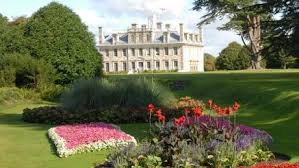
There can be few more romantic and stirring stories in the history of British landed gentry than that of Dorset’s Bankes family in the seventeenth century. Even now you can still feel the excitement of it all as you drive south on the A351 from Wareham towards Swanage and catch that first magical glimpse of the ruined Corfe Castle sitting resolutely on its mound in a gap in the Purbeck hills. Then there’s Kingston Lacy, just twelve miles to the north as the crow flies. It sits in glamorous elegance – redolent with history – just off the leafy B3082 near Wimborne Minster.

Sir John Bankes, Lord Chief Justice, bought the estates dominated by Corfe Castle in 1635. Corfe already had more than five centuries of history to its credit, having begun life just after the Norman conquest and having enjoyed a long innings as as a royal castle for the peripatetic medieval courts. At the time of Sir John’s purchase the castle was in quite a good state of repair and the Bankes family – John and his wife Mary, with children and servants – were able to make it their home.

At the same time Sir John acquired other land in the Isle of Purbeck as well as quickly buying up various other Dorset properties.

The 1630s were strange times. Loyalty to King Charles I was severely strained. A parliamentary ‘party’ who opposed the authoritarianism of the king had evolved and as the years passed there was a pervasive sense that trouble was brewing. Sir John Bankes was a committed royalist. 1642 found him away from his family in the service of the king, beleagured at Oxford. England was divided by civil war.

By the spring of 1643 almost all of Dorset had been taken by parliamentary forces. Corfe, however, was not.  And the indomitable Mary Bankes was determined to keep it that way. Because she received a tip-off that an attack was imminent she was able to barricade herself and her dependents inside the castle where they withstood a weeks-long seige, notwithstanding the destruction of the buildings in Corfe village, the homes of the villagers who were inside the castle with Lady Bankes. Eventually she conceded four small cannon and won a bit a peace and independence.

During the lull, the ever resourceful Lady Bankes – a female crisis manager centuries ahead of her time and right out of synch with the prevailing attitudes of her age –  was able to lay in some provisions and to recruit some extra manpower. Sir John visited his wife and family later in the year before rejoining the King at Oxford where he died in December 1644.

Within six months of becoming a widow Lady Bankes was once again being ambushed at Corfe by parliamentary soldiers in their round-headed helmets. The miniature of her at Kingston Lacy shows a calm intelligent, fairly plain woman gazing thoughtfully at the artist. So impressed was the parliamentarian Colonel Bingham with Mary Bankes’s courage that at the end of the final siege he allowed her to keep the seal and keys of the castle which today are on display at Kingston Lacy. The castle was demolished by act of parliament. In one sense a deadful act of vandalism; in another the creation of one of the prettiest ruins in Britain. It’s wonderfully evocative to wander round and through those ruins with their view for miles in every direction, too.

So what became of her? She went with her children to live in safety at Ruislip, near London. After the Restoration of the monarchy in 1660  some money and land was returned to the Bankes family. Mary’s son, Ralph, was knighted and he moved back to Dorset. His mother died at Blandford in 1661.

Ralph, of course, needed a home: a new family seat, in fact. He commissioned Roger Pratt the architect who worked on the new Kingston Hall, near Wimborne, in the mid-1660’s. Pratt and Ralph Bankes had both travelled in Italy during the interregnum and their architectural ideas were very Italianate. It’s a very tranquil house – appropriately so considering it was built in the peacetime aftermath of a  dreadful civil war. Some of Pratt’s drawings – along with those by Brettingham and Barry for the eighteenth and nineteenth century additions – are fascinatingly displayed in the house today.

Succeeding generations of the colourful Bankes family lived at Kingston Hall, which metamorphosed as Kingston Lacy in the mid nineteenth century,  for over three hundred years  until 1981 when the reclusive Ralph Bankes died.

All the Bankes land: both the Corfe Castle and the Kingston Lacy estates were beqeathed by  Ralph Bankes to the National Trust for public enjoyment and interest. It was one of the biggest legacies to the nation of all time and for those of us who love Dorset this has made it even better. Let’s make the most of it.

Corfe Castle, Wareham BH20 5EZ  (01929) 481294 [email protected],uk

 Kingston Lacy, Wimborne Minster, BH21 4EA  (01202) 883402 [email protected]

Both open daily.  Check times on website.

I’ve been banging on about terrible lavatories  in theatres and other performing arts centres for years. In far too many cases provision – especially for women – is direly inadequate to the point of insult. https://www.thestage.co.uk/opinion/2015/susan-elkin-adequate-provision-loos-elemental-theatre-design/

Here are the facts: Women take longer in the loo than men.  Conventionally they need to lock themselves into a cubicle even to urinate. Often – more often, in practice, than men even in enlightened 2016 – they have children with them which slows things up. That’s why long queues snaking out of the ladies are the norm during theatre intervals. You rarely see chaps having to queue. Action is long overdue. Women need MORE facilities than men.

I was therefore delighted to see that benefactors Susan and Simon Ruddick (of course there’s a woman involved) have given Theatres Trust £125,000 to be distributed in grants to ten theatres wanting to improve women’s lavatories. It’s called the “Spend a Penny Scheme” – nice bit of historical referencing by the way. It now costs 50p (120 old pennies) to “spend one” at Victoria Station but we’ll let that pass.

The closing date for theatres to apply for such a grant is 26 October and decisions will be made in December about which applications are successful. Wouldn’t it be good if other benefactors followed suit so that many more (all?) theatres could really improve their lavatories?

Meanwhile I’m really looking forward to finding more facilities in more places where there is actually room to pull my knickers up, a bit of floor to stand on while I wash my hands without splashing my feet and – maybe – shorter queues

Could unisex be the answer to the West End’s toilet troubles?

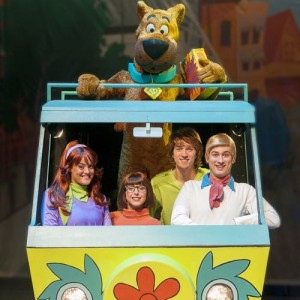
Scooby-Scooby-Doo-Live-Musical-Mysteries-London-Palladium-18-21-August-7-300x300The Scooby-Doo cartoons are a pretty iconic example of 1960s cartoon culture and held in great affection by those who grew up with them. The trouble is that they are now so well known they’ve turned into a ‘brand’ and that is rarely a  basis for good quality theatre.

The creators are so busy keeping the brand recognisable that there is no scope for imagination, surprise or anything theatrically interesting. It becomes a matter of feeding the theatrically unsophisticated audience more of what they already know, and frankly they might as well be at a film …

Read the rest of this review via Musical Theatre Review http://musicaltheatrereview.com/scooby-doo-live-musical-mysteries-london-palladium/

marilyn-pin-Erin-Gavin-300x300

This exploration of the relationship between Marilyn Monroe and Frank Sinatra is predicated on author Sandro Monetti’s discovery that Monroe played a stack of Sinatra’s records the night she died of a drugs overdose in 1962. His voice was therefore the last she heard. This bijoux piece – billed at one hour but actually coming in at 15 minutes less – imagines and explores their connections, some of them pretty intimate, between 1954 and 1962 ….

Read the rest of this review via Musical Theatre Review http://musicaltheatrereview.com/marilyn-and-sinatra-jermyn-street-theatre/